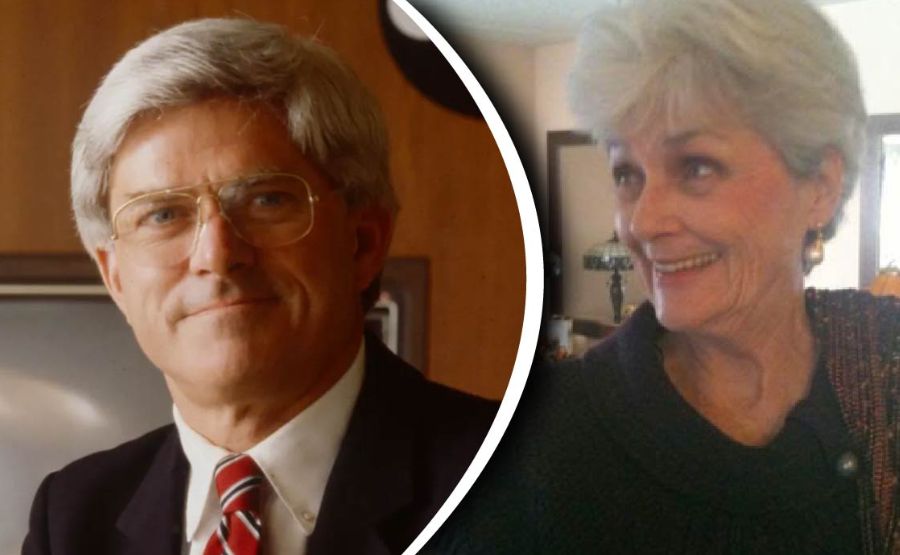
Marge Cooney: The Woman America Never Watched
A biography of Margaret Mary Cooney — mother, Catholic homemaker, community volunteer, and the quietly resolute first wife of television pioneer Phil Donahue — whose deliberate refusal of the spotlight illuminates, by contrast, the full human cost of fame.
Quick Bio
| Full Name | Margaret Mary Cooney |
| Known As | Marge |
| Born | 1936, West Orange, New Jersey, USA |
| Died | February 2, 2018, Brandywine at Wall, Wall Township, New Jersey |
| Age at Death | 82 |
| Nationality | American |
| Religion | Roman Catholic |
| Parents | Mr. and Mrs. James B. Cooney |
| Sibling | James “Jim” Cooney (brother) |
| Childhood Homes | West Orange, NJ; Chatham, NJ; Boca Raton, FL |
| Summer Home | Sea Girt, New Jersey (for 57 consecutive summers) |
| Education | St. Mary’s High School; College of Mount St. Joseph, Cincinnati, OH; Marquette University, Milwaukee, WI |
| First Marriage | Phil Donahue (married February 1, 1958; divorced 1975) |
| Wedding Location | San Felipe de Neri Church, Albuquerque, New Mexico |
| Children | Michael Donahue (b. 1959), Kevin Donahue (b. 1960), Daniel Donahue (b. 1961), James “Jim” Donahue (b. 1963; d. 2014), Mary Rose Donahue (b. 1965) |
| Post-Divorce Custody | Mary Rose (with Marge); four sons (with Phil) |
| Second Marriage | Remarried (husband’s name never publicly disclosed) |
| Post-Divorce Residence | Albuquerque, New Mexico; later New Jersey and Boca Raton, Florida |
| Church Membership | St. Mark’s Church, Sea Girt, NJ; St. Joan of Arc Church, Boca Raton, FL |
| Social Memberships | Spring Lake Golf Club |
| Family Home During Marriage | Centerville, Ohio (neighbor: humorist Erma Bombeck) |
| Public Role | Homemaker, community volunteer |
| Ex-Husband’s Death | Phil Donahue died August 18, 2024, age 88 |
Why Marge Cooney’s Story Still Matters
In a culture that has spent decades discussing women left behind by their famous husbands, Margaret Mary Cooney stands as a clarifying case study — a woman who chose disappearance not because fame defeated her, but because she evaluated what it offered and declined.
In her own life, she wasn’t a helpless observer. She attended university at a time when many women did not. She held a professional position before marriage. She endured a divorce in 1975, when Catholic social stigma around divorce ran deep, and rebuilt herself without seeking sympathy or attention. These were active choices made by a woman with a coherent set of values — faith, family, community — and the discipline to live by them even when the easier path was already lit by her former husband’s studio lights.
Marge Cooney died on February 2, 2018, at age 82. No major publication ran an obituary. The country that had watched Phil Donahue for twenty-nine years barely noticed that his first wife was gone. That asymmetry — between his visibility and her invisibility — is the most honest thing her story can teach us about what fame costs the people who surround it.
See also “Shamicka Gibbs: How a Woman Hollywood Tried to Footnote Wrote Her Own Story“
The New Jersey Years: Roots, Faith, and the Shore
West Orange, New Jersey, in 1936 sat comfortably within the postwar American Catholic universe — a world of parish schools, large families, neighborhood liturgies, and the quiet conviction that how you raised your children was the most consequential work you would ever do.
Margaret Mary Cooney entered that world as the daughter of Mr. and Mrs. James B. Cooney, a household that prized education and religious devotion in equal measure. The family did not stay anchored to one address. They spent time in Chatham, New Jersey, during her formative years, and later established deep roots in Boca Raton, Florida, where Marge would eventually live for approximately three decades of her adult life.
But one location held her with a constancy that no other place matched. Sea Girt, New Jersey — a small, unassuming shore town on the central Jersey coast — became the gravitational center of her emotional geography. She summered there for fifty-seven years. That number rewards attention. Fifty-seven summers traces a continuous line from her girlhood, through marriage, through the upheaval of divorce, through a second marriage, through the death of a son, and into the quiet final chapter of a long life. Sea Girt endured when nearly everything else shifted.
Her education began at St. Mary’s High School, where those who knew her consistently described her as thoughtful, gentle, and academically capable. She then enrolled at the College of Mount St. Joseph in Cincinnati, Ohio — a Catholic institution that reinforced the values her family had already planted. Later, she pursued graduate-level study at Marquette University in Milwaukee, Wisconsin, a Jesuit university with a rigorous academic tradition. For a woman of her era, this educational arc was not standard. Most of her contemporaries stopped well short of graduate school.
How a Brother’s Friendship Changed Everything
The story of how Marge Cooney met Phil Donahue begins not with romance but with male friendship, and with a piece of biographical luck that reshaped both their lives.
During his years studying at the University of Notre Dame in South Bend, Indiana, Phil Donahue immersed himself in theater. It was through those artistic circles that he met and befriended a young man named Jim Cooney — Marge’s brother. The friendship formed quickly and genuinely. Jim Cooney subsequently introduced his sister to Phil.
Donahue himself later described the moment he first saw Margaret Cooney: a tall, striking young woman in an overcoat buttoned high around her neck. The attraction was not instantaneous courtship. The timeline moved slowly, as it often does when both parties are serious people with other commitments. Marge eventually left school and relocated to Chicago, where she worked at Price Waterhouse in the Prudential Building — a professional position that situated her in the heart of one of the nation’s major financial firms at a moment when relatively few women held such roles.
Phil was still completing his Notre Dame degree. The distance between Chicago and South Bend did not dissolve what they had found. Both graduated in 1957. They became engaged that year. On February 1, 1958, in a Solemn High Nuptial Mass officiated by three priests, they married at San Felipe de Neri Church in Albuquerque, New Mexico — one of the oldest Catholic churches in the United States, its adobe walls thick with centuries of community ritual. She was twenty-two years old. He was twenty-two. Neither of them could have named what was approaching.
Seventeen Years and Five Children: The Marriage in Full
The arithmetic of the Donahue marriage is striking in its compactness. Marge Cooney gave birth to five children in just six years, from 1959 to 1965. Michael arrived in 1959, Kevin in 1960, Daniel in 1961, James in 1963, and their only daughter, Mary Rose, in 1965.
When The Phil Donahue Show premiered in Dayton, Ohio, on November 6, 1967, Marge was home in Centerville, Ohio, managing five children under the age of ten. The family’s Centerville home sat directly across the street from Erma Bombeck, the syndicated humorist who would rise to national prominence writing wryly and wisely about the particular demands of domestic life. It is one of those coincidences that feels almost designed: two women, across a suburban Ohio street, both navigating the intersection of family and a husband’s career, both doing so with more intelligence and complexity than the mid-century domestic script gave them credit for.
Phil Donahue’s show moved from Dayton to Chicago in 1974. By that point, his program had entered nationwide syndication in January 1970 and turned him into a familiar face across American living rooms. He later acknowledged, without defensiveness, that he had been “the traditional workaholic guy who had traditional expectations” of his wife during those years. His ambition was not concealed. Building something that had never been built before — a daytime talk show structured around audience participation, willing to discuss abortion, civil rights, and consumer protection when other programs avoided all three — demanded the kind of total professional absorption that leaves very little for the home.
In 1973, the marriage fractured. The couple separated for ten months, then attempted reconciliation, reportedly for the sake of their children. The effort lasted four months. In 1975, after seventeen years, the divorce was finalized. The reasons were kept entirely private. Neither Marge nor Phil ever offered a public accounting. The silence on that subject was complete and deliberate, and it deserves to be honored as such.
The Divorce and the Road to Albuquerque
The custody arrangement that emerged from the 1975 divorce was unusual enough to prompt decades of quiet commentary. Phil retained custody of the four sons — Michael, Kevin, Daniel, and James — while Marge gained custody of their only daughter, Mary Rose. She was then ten years old.
Why the split ran along gender lines, and why Marge left four of her children in Ohio while she returned to New Mexico with one, has never been explained in any public record or statement. The silence around this arrangement may reflect the particular calculus of a Catholic family navigating a difficult legal dissolution in 1975, or it may reflect agreements reached for pragmatic reasons about geography, careers, and what each parent could realistically provide. Whatever the reasoning, the outcome stands: Marge Cooney moved to Albuquerque with her daughter and stepped out of the public world entirely.
She remarried. According to a 1980 Washington Post profile of Phil Donahue, Margaret returned to New Mexico after the divorce and took a second husband. His identity has never been publicly confirmed, and Marge herself never addressed her second marriage in any interview or statement, because she gave none. It is one of the most complete acts of biographical self-erasure in recent American celebrity-adjacent life — a woman who was once photographed beside one of the country’s most recognizable television personalities, choosing thereafter to live entirely outside the record.
In Albuquerque, she was not the ex-wife of a famous man. She was Marge, a woman building a life around a daughter, a faith, and a community.
Personal Life: Faith, Grief, and the Strength That Kept Going
Two anchors sustained Marge Cooney through the most turbulent decades of her adult life: her Catholic faith and her commitment to the communities that faith organized.
She joined St. Mark’s Church in Sea Girt, New Jersey, as a parishioner and remained active there for years, attending services, participating in prayer groups, and helping others in the congregation. She volunteered regularly at St. Joan of Arc Church in Boca Raton, Florida, during the long decades she spent in that city. She also held membership at the Spring Lake Golf Club, a social institution that gave her access to community and friendship in the quieter register she preferred. These were not performed gestures of piety. They were structural pillars — the scaffolding that held a life together when marriage, distance, and grief put pressure on it.
The grief came with particular force in 2014. James “Jim” Donahue — her youngest son, the boy born in 1963 — died suddenly in April of that year at age fifty-one from a ruptured aortic aneurysm. Jim had built a meaningful adult life. He had worked as an investigative researcher and writer for a nonprofit organization affiliated with consumer advocate Ralph Nader. He had later become a lawyer and settled in Honolulu, Hawaii, where he practiced law and was remembered by colleagues as passionate, principled, and committed to justice. His ashes were scattered in the waters off Honolulu — the city he had chosen as home.
Marge Cooney had outlived her youngest child. There is no adequate sentence to contain what that means. She continued. She kept attending services. She kept showing up at Sea Girt each summer. She kept living according to the values she had carried her entire life, because that is what people of genuine faith and discipline do when the worst happens. They keep going.
The Centerville Years: Next-Door to American Life
The years the Donahue family spent in Centerville, Ohio, provide one of the biography’s most resonant details. Their home sat across the street from the house belonging to Erma Bombeck.
Bombeck, who would publish her first nationally syndicated column in 1965, was building a body of work grounded in the sharp observation of domestic life — the relentless, often invisible labor of running a household, raising children, and sustaining a family that a culture obsessed with male achievement consistently undervalued. She and Phil Donahue would eventually become contemporaries on the national stage, both addressing American audiences about subjects that mattered to ordinary people.
The fact that Marge Cooney lived across the street from that particular woman, during the years when she was raising five children while her husband’s career ascended, feels almost too symbolically perfect. Bombeck was describing, in print, the life Marge was living in practice. Neither of them, in those Centerville years, commanded the spotlight. Both of them understood exactly what was required to keep a household, a marriage, and five young lives moving forward in the same direction.
Also present in the Donahue household during the 1970s, for a brief period: Vivian Maier, the American street photographer who spent decades working in obscurity as a nanny before her work was posthumously discovered to be among the most significant photography of the twentieth century. Phil Donahue employed Maier to care for his children after the marriage ended. The unintended coherence between these biographical threads—a trailblazing TV host, an inconspicuous photographer, and the first wife who opted to stay hidden—is remarkable.
The Life After Fame: Community, Continuity, and a Chosen Privacy
After returning to New Mexico and remarrying in the late 1970s, Marge Cooney lived for decades without ever appearing in a photograph connected to Phil Donahue’s story, without granting a single interview, and without placing herself in any public narrative about her former husband’s career or her own role in it.
The only confirmed public image of her alongside her first family after the divorce appeared in Phil Donahue’s 1980 memoir, Phil Donahue: My Own Story, where a family photograph included Marge and their five children. That is the entire public record she allowed.
She eventually migrated between New Mexico, Boca Raton, and the New Jersey shore community that had always mattered most to her. In her later years, she spent time in Sea Girt in the summers and maintained her connections to both church communities that had sustained her through the difficult decades. The Spring Lake Golf Club provided social continuity, a community of friendships built on proximity and shared ritual rather than celebrity.
While the public’s awareness of her remained frozen at the 1975 divorce — “Phil Donahue’s first wife” — the woman herself continued to evolve, grieve, worship, volunteer, age, and build a life that bore no relationship to that reductive label.
She died as she had lived: surrounded by her children and extended family, at Brandywine at Wall, a senior care residence in Wall Township, New Jersey. The date was February 2, 2018. She was eighty-two years old.
Legacy and Influence: What Absence Teaches
No institution bears Marge Cooney’s name. No scholarship honors her choices. No television retrospective has examined the woman who spent seventeen years keeping the household functional while her husband remade American television from the inside.
Her legacy operates through people rather than platforms. Mary Rose Donahue grew up in her mother’s household in Albuquerque, raised by a woman who had chosen her daughter’s stability over her own proximity to fame. The four sons — Michael, Kevin, Daniel, and the late James — grew up in their father’s household but within a family shaped by a mother whose values of faith, discipline, and community remained present across the distance.
Phil Donahue’s second wife, actress and activist Marlo Thomas, whom he married on May 21, 1980, reportedly became a genuine presence in the lives of all five children — a relationship that by multiple accounts was warm and enduring. That outcome suggests a co-parenting arrangement, at least in its long-term effects, that served the children even across geographic and temperamental distance.
What Marge Cooney’s life offers the broader cultural conversation is harder to quantify but no less real. She represents the generation of women whose labor, emotional management, and daily sustenance of a household enabled the careers of men who went on to transform their industries. Phil Donahue openly acknowledged as much — the workaholic husband with “traditional expectations” he described in retrospect. That acknowledgment matters. So does the recognition that the woman whose domestic work underwrote that career chose never to leverage it, commodify it, or use it as a platform for her own advancement.
In an era when every private experience is presumed to be content waiting for publication, Marge Cooney’s deliberate silence about her marriage, her divorce, her grief, and her second life constitutes its own kind of moral statement. Not everyone who lived through something significant owes the world an account of it.
Final Words
To write about Marge Cooney is to write about an absence she engineered herself. The sources available — celebrity biography websites, a passing Wikipedia reference, church records implied in obituary notices — tell us the outline of a life without ever capturing the interior.
What we know, with reasonable confidence: she was born in New Jersey in 1936, educated at three universities, married in an ancient New Mexican church on the first day of February 1958, and spent the next seventeen years raising five children in the shadow of her husband’s expanding celebrity. She endured a divorce that would have been socially and spiritually costly for a woman of her generation and faith. She rebuilt. She remarried. She raised a daughter. She buried a son. She kept attending church. She kept returning to Sea Girt every summer. She died in a New Jersey care home in February 2018, surrounded by the people she had loved most, and the country did not notice.
Phil Donahue received the Presidential Medal of Freedom from President Joe Biden on May 3, 2024. He died four months later on August 18, 2024, at age eighty-eight, and the tributes were numerous and sincere. The man had genuinely changed American television.
The woman who helped make the conditions of that change possible — who ran the household in Centerville while he built an institution in Dayton, who raised five children while he spoke to millions about the issues of the day — received no comparable recognition, because she neither sought it nor required it.
There is no tragedy in that, if we take her choices seriously. The tragedy would be in insisting that her life only mattered because a famous man once shared it. Marge Cooney’s life mattered because she lived it with intention, faith, and a particular kind of courage that asks nothing of an audience.
FAQs
1. Who was Marge Cooney?
Margaret Mary Cooney was an American homemaker and community volunteer born in West Orange, New Jersey, in 1936. She is best known as the first wife of television host and talk show pioneer Phil Donahue, with whom she was married from 1958 to 1975.
2. When and where was Marge Cooney born?
She was born in 1936 in West Orange, New Jersey. Her exact birth date was never made public. She grew up partly in Chatham, New Jersey, and later spent extended periods in Boca Raton, Florida.
3. Where did Marge Cooney go to school?
She attended St. Mary’s High School for secondary education, then the College of Mount St. Joseph in Cincinnati, Ohio, for her undergraduate studies. She also pursued graduate-level education at Marquette University in Milwaukee, Wisconsin.
4. How did Marge Cooney meet Phil Donahue?
Through the theater circles at Notre Dame, her brother Jim Cooney made friends with Phil Donahue. Jim introduced his sister to Phil, beginning a courtship that survived long distance — Marge working at Price Waterhouse in Chicago while Phil finished his degree — and led to their engagement in 1957.
5. When and where did Marge Cooney marry Phil Donahue?
On February 1, 1958, they tied the knot at Albuquerque, New Mexico’s San Felipe de Neri Church. The ceremony was a Solemn High Nuptial Mass conducted by three priests, attended by close family and friends.
6. How many children did Marge Cooney have?
She had five children with Phil Donahue: Michael (born 1959), Kevin (1960), Daniel (1961), James “Jim” (1963), and Mary Rose (1965).
7. Why did Marge Cooney and Phil Donahue divorce?
The couple divorced in 1975 after seventeen years of marriage. The reasons were kept entirely private. They separated briefly in 1973 for approximately ten months, attempted reconciliation for four more months, then separated permanently. Neither ever publicly explained the breakdown.
8. What was the custody arrangement after the divorce?
Marge was granted custody of their daughter, Mary Rose, while Phil kept custody of their four sons, Michael, Kevin, Daniel, and James. This unusual gender-split arrangement was never publicly explained by either parent.
9. Did Marge Cooney remarry?
Yes. According to a 1980 Washington Post profile of Phil Donahue, she remarried after returning to New Mexico. Her second husband’s identity has never been publicly confirmed.
10. What happened to her son James Donahue?
James “Jim” Donahue, Marge’s youngest child, died in April 2014 at age fifty-one from a ruptured aortic aneurysm. He had worked as an investigative researcher for a Ralph Nader-affiliated nonprofit and later became a practicing lawyer in Honolulu, Hawaii. The waters off Honolulu were filled with his ashes.
11. Was Marge Cooney involved in her community?
Yes, deeply. She served as a parishioner at St. Mark’s Church in Sea Girt, New Jersey, volunteered at St. Joan of Arc Church in Boca Raton, Florida, and held membership at the Spring Lake Golf Club. Her community involvement was consistent and quiet throughout her adult life.
12. Where did Marge Cooney live for most of her life?
She moved among several locations: she grew up in New Jersey, married in New Mexico, lived in Centerville, Ohio, during the marriage, and returned to Albuquerque, New Mexico, after the divorce. She subsequently divided time between Boca Raton, Florida (for approximately thirty years), Sea Girt, New Jersey (where she summered for fifty-seven consecutive years), and ended her life in Wall Township, New Jersey.
13. When and how did Marge Cooney die?
She died on February 2, 2018, at Brandywine at Wall, a senior care residence in Wall Township, New Jersey. She was eighty-two years old. Her children and extended family were present at her death. No national obituary or press release appeared.
14. Did Phil Donahue outlive Marge Cooney?
Yes. Phil Donahue died on August 18, 2024, at age eighty-eight — more than six years after Marge’s death. His passing prompted extensive media coverage and tribute; hers did not.
15. Why is Marge Cooney’s story considered significant today?
Her story offers an honest account of the domestic labor and personal cost that often underwrote the careers of famous men in the mid-twentieth century. It also serves as a study in agency: she was a woman with education, connections, and access to celebrity who chose privacy deliberately and sustained that choice for over four decades. Her refusal to disclose is a statement in and of itself in a media culture that assumes public openness by default.
Connecting curious minds with stories that educate, inspire, and inform with The Editorial Times.