Loray White: A Woman Caught in History’s Machinery
A biography of Loray Betty White — Houston-born dancer, singer, actress, entrepreneur, and the woman whose acquiescence to an arranged marriage in January 1958 illuminates, with uncomfortable precision, how racial terror shaped individual lives at the height of Hollywood’s golden age.
Quick Bio
| Detail | Information |
| Full Name | Loray Betty White |
| Professional Name | Also known as Sonora |
| Born | November 27, 1934, Houston, Texas, USA |
| Nationality | American |
| Race/Ethnicity | African American |
| Parents | Harold White (father); Joyce Mae Mills (mother) |
| Education | Sawyer Business School; University of California |
| Profession | Dancer, singer, actress, writer, public relations executive, producer |
| First Marriage | Unknown first husband (divorced; one child from this marriage) |
| Daughter | Deborah DeHart White |
| Second Marriage | Sammy Davis Jr. (married January 10, 1958, Emerald Room, Sands Hotel, Las Vegas; divorced April 1959) |
| Reason for Marriage | Arranged contract marriage to protect Davis from mob threats connected to Harry Cohn and Columbia Pictures |
| Payment Received | Lump sum between $10,000 and $25,000 plus $17,000 for accumulated bills |
| Filing for Divorce | September 1958, on grounds of mental cruelty |
| Divorce Finalized | April 1959 |
| Children with Davis | None |
| Notable Film Appearances | The Ten Commandments (uncredited, as Nubian Slave); The Notorious Cleopatra (1970); Miss Nymphet’s Zap-In (1970); appeared as herself in Lionel Hampton and Herb Jeffries (1956) |
| Writing Career | Entertainment writer, Los Angeles Community News (1970–1981) |
| Business Founded | LBW & Associates Public Relations (established 1980) |
| Production Work | Director and producer, Yesterday, Today, Tomorrow, Los Angeles (1981–2005) |
| CBS Work | Worked with Columbia Broadcasting System news department (1999) |
| Current Status | Whereabouts unknown as of 2026; it is unclear whether she is still alive |
A Woman Whose Story the Record Nearly Erased
Loray White still matters today because her story exposes — with stark documentary clarity — how racial violence, corporate power, and organized crime conspired in 1950s America to consume the agency of an ordinary woman who happened to be standing in the wrong spotlight at the right moment.
She was not famous. She was not a star. She was a twenty-three-year-old Black dancer and singer working the Las Vegas club circuit, raising a daughter, and building a modest career in the entertainment industry that surrounded her. Then Sammy Davis Jr. scanned an address book looking for a Black woman to marry in under forty-eight hours — and her name appeared.
What happened next made her briefly famous across the country. What happened after that is the part history consistently forgets to tell.
See also “Ramzi Habibi: The Quiet Architect of Capital“
Houston Roots: A Life Before the Storm
Loray Betty White entered the world on November 27, 1934, in Houston, Texas. Her parents were Harold White and Joyce Mae Mills. The record does not describe their professions in confirmed detail, and Loray herself never offered public accounts of her childhood. What Houston in 1934 does tell us is the context she was born into: a racially segregated city in a state that enforced Jim Crow with legal and extralegal force, where the ambitions of Black children ran immediately into the walls that white America constructed around them.
She sought education beyond the stage. She attended Sawyer Business School, acquiring practical administrative and commercial skills. She later studied at the University of California — an institution and a city that represented something Houston could not offer: cultural complexity, proximity to the entertainment industry, and a measure of social distance from the South’s most rigid racial architecture.
By her early twenties, she had already lived through one marriage and one divorce, and was raising a young daughter named Deborah DeHart White. This is an important biographical context that most accounts of her life omit or mention only in passing. Before she ever met Sammy Davis Jr., Loray White had already survived the early adult experiences that typically age a person past sentimentality: a marriage that failed, single parenthood, and the daily labor of keeping a performance career alive in an industry that offered very little to Black women who were not already famous.
Las Vegas, 1957: Building Something Real
By the late 1950s, Loray White had established herself as a working entertainer in Las Vegas. She performed regularly at the Silver Slipper — a casino nightclub on the Las Vegas Strip that operated as a significant venue in the city’s entertainment ecosystem. The Silver Slipper was not the headliner circuit. It was a working performer’s room, the kind of venue that kept a singer employed and developing rather than catapulting them to national fame.
She also worked as a dancer and appeared on screen in modest but documentable capacities. Her uncredited appearance in Cecil B. DeMille’s The Ten Commandments — one of the highest-grossing films of the entire 1950s, released in 1956 — placed her inside the background of an immense Hollywood production, in the kind of minor role available to Black women in that era regardless of their talent. She appeared as herself in a 1956 production featuring Lionel Hampton and Herb Jeffries, two established figures in Black American entertainment. These were real professional credits, accumulated by a woman building a career on the industry’s margins.
She also carried a professional performing name — Sonora — a stage identity distinct from her given name, suggesting awareness of how personal branding worked in the entertainment world and a deliberate construction of professional identity separate from her private self.
The world she occupied was glamorous on its surface and brutal underneath. Las Vegas in 1957 was booming and racially segregated simultaneously. Black entertainers performed in casino showrooms where they could not eat at the hotel restaurants or stay in the hotel rooms. The industry that exploited their talent denied them the basic dignities it extended to white performers without thought. Loray White worked within these constraints as a matter of daily professional life, not as an exceptional circumstance but as the permanent condition of her occupation.
The Machine Closes In: January 1958
The events that produced Loray White’s marriage to Sammy Davis Jr. were not romantic. They were political, commercial, and violent — a collision of organized crime, studio power, and American racial law that placed two individuals at the intersection of forces neither could control.
Davis, born December 8, 1925, in New York City, had been conducting a secret relationship with Kim Novak — Columbia Pictures’ biggest box office star in 1957, a year in which Novak appeared in Pal Joey and was riding the commercial peak of Hitchcock’s Vertigo. Their meetings happened in concealment: Davis hiding under blankets in the back of a car to avoid photographers, private gatherings at a rented Malibu beach house facilitated by Davis’s assistant Arthur Silber Jr. When gossip columnist Dorothy Kilgallen published a veiled reference to the relationship, using initials rather than names, the studio machinery engaged immediately.
Harry Cohn, Columbia Pictures’ studio chief — a man known for his admiration of Benito Mussolini, his close ties to Chicago mob figure Johnny Roselli, and his treating Kim Novak as property rather than person — exploded in rage. In January 1958, the threat came through Mickey Cohen, boss of the Cohen crime family. Cohen found Davis’s father, Sammy Davis Sr., at a racetrack and delivered the message plainly: if Sammy did not marry a Black woman within forty-eight hours, they would break both his legs and destroy his remaining eye. Davis had already lost his left eye in a 1954 car accident. The threat was specific, targeted, and credible.
Davis had sought protection from his own organized crime contacts, including Sam Giancana. Giancana told him plainly: he could protect Davis in Las Vegas and Chicago, but had no reach in Hollywood. The wedding was, in cold terms, the only calculation that made physical survival possible.
Davis sat in his suite at the Sands Hotel with his address book. He scanned names. He landed on Loray White’s — a woman he had taken on a handful of dates, who worked at the Silver Slipper across from the Sands, whom he knew to be available and whom he trusted, in the limited way one trusts someone one has briefly dated, not to create additional complications.
He called her. He made the proposition explicit: marry him, perform the role of Mrs. Sammy Davis Jr. for a defined period, and the marriage would be dissolved. In return, he would pay $17,000 in accrued expenses and she would receive a lump amount (accounts range from $10,000 to $25,000). The arrangement had the structure of a contract, not a romance.
She agreed.
The question of why she agreed deserves more careful consideration than most accounts give it. The explanations offered — that she needed money, that she wanted to help someone in danger, that it represented a business calculation — are not mutually exclusive and may all be partially true. What is also true is that a twenty-three-year-old Black single mother working the Las Vegas club circuit in 1958 had very limited options when a famous man sitting in a room full of organized crime pressure asked for a specific favor. Consent in that context is real but also constrained by the asymmetry of power operating in all directions.
The Wedding That Was Never a Marriage
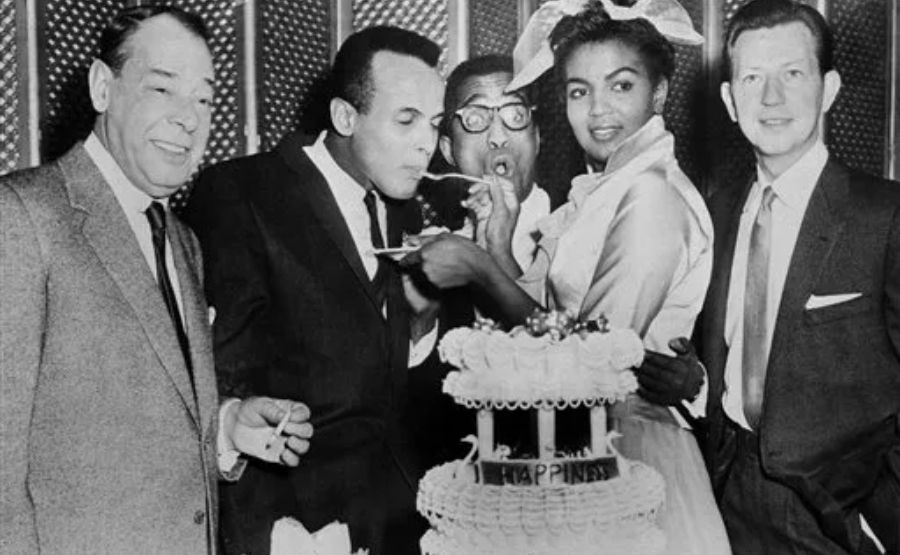
On January 10, 1958, in the Emerald Room of the Sands Hotel in Las Vegas, Loray White and Sammy Davis Jr. married before a justice of the peace. Singer Harry Belafonte served as best man. Photographs from the wedding show Davis and White drinking from an oversized martini glass beside a tiered cake decorated with the word “Happiness.” The images look, at first glance, like celebration.
The reality inside the car en route to the wedding suite was something else entirely. Arthur Silber Jr., who drove the couple, later described Davis as heavily intoxicated and so emotionally shattered that Davis attempted to strangle White in the car. Silber physically restrained Davis and separated them. Silber found Davis later with a gun to his head. Davis said to Silber: “Why won’t they let me live my life?”
Loray White endured the violent wedding night of a man in crisis, caused by forces that had nothing to do with her and everything to do with the racism, mob connections, and studio power politics of 1950s Hollywood. She was the instrument through which others resolved a problem she did not create.
The couple never lived together after the wedding. The marriage existed as a legal status and a public performance — photographs, appearances — rather than a domestic reality. By September 1958, newspapers were reporting the imminent divorce. Loray filed on grounds of mental cruelty. The grounds were accurate. The divorce was granted on April 24, 1959, as documented by an Associated Press item published in the Daily Press of Newport News, Virginia.
Davis paid her the agreed lump sum and covered the $17,000 in bills. The settlement was not generous by any standard other than comparison to the nothing that might alternatively have been offered. The marriage produced no children. It produced, instead, a set of newspaper photographs, a legal record, and a life experience that Loray White carried forward into the decades that followed.
Personal Life: What We Know and What We Don’t
The private life of Loray White is, by the standard of publicly documented biography, a nearly empty record. This is not unusual for Black women entertainers working at the margins of the industry in the 1950s and 1960s — the historical archive was not built to preserve their experiences in any systematic way. What it preserved was primarily what touched the more famous people in their orbits.
Before the Davis marriage, she had already been through one earlier marriage and divorce. Her daughter Deborah DeHart White was born from that first marriage. No confirmed public information exists about the identity of her first husband, the circumstances of that divorce, or when it occurred. Wikipedia’s entry on Sammy Davis Jr. notes that at the time of the 1958 marriage, White was “twice divorced” — which, if accurate, means there may have been two prior marriages rather than one.
After the dissolution of the Davis marriage in April 1959, Loray White disappeared almost entirely from the celebrity-adjacent public record. Whether she maintained relationships, formed new ones, or remarried after 1959 is not documented in any source consulted. She raised her daughter. She built a professional second life. Whether she found companionship or love beyond the frame of what got written down is simply unknown.
What the record does contain is a portrait of someone who, when facing the worst of what the entertainment industry could offer — a coerced marriage, a violent wedding night, public scrutiny attached to someone else’s crisis — chose to file her own legal paperwork, invoke mental cruelty as the grounds, and extract herself on her own terms. It was a limited form of agency. It was still an agency.
The Second Career: Writing, PR, and a Long Project
After the 1959 divorce, Loray White did not retreat from professional life. She redirected it. The business education she had accumulated at Sawyer Business School and the University of California proved useful in ways her performing career had not fully required.
From 1970 to 1981, she worked as an entertainment writer for the Los Angeles Community News. The role kept her inside the entertainment world she had spent the 1950s performing in — but from a different position: as an observer, interpreter, and narrator rather than as a performer seeking an audience’s approval. The shift from stage to press represents a significant reorientation of professional identity, and she sustained it across more than a decade.
In 1980, she founded LBW & Associates Public Relations — her own firm, bearing her initials. The creation of an independent PR company by a Black woman in Los Angeles in 1980 required not just business knowledge but the kind of sustained professional credibility that takes years to build. It wasn’t the behavior of someone who had given up on ambition. It was the act of someone who had converted experience — including the experience of being instrumentalized by the entertainment industry at its worst — into professional capital.
Beginning in 1981, she directed and produced a project called Yesterday, Today, Tomorrow, Los Angeles — a long-running production that she worked on continuously until 2005. The twenty-four-year duration of that single project is remarkable. It suggests not a fleeting creative impulse but a sustained commitment to a specific documentary or archival work centered on Los Angeles, the city that had been both the site of her greatest professional humiliation and the ground on which she rebuilt herself.
In 1999, she worked with the Columbia Broadcasting System’s news department — adding broadcast journalism to a resume that already contained performing, entertainment writing, public relations, and long-form production.
The Hollywood Context: Racial Terror in the Entertainment Industry
Loray White’s story cannot be fully understood without the context of American racial law and violence in 1958. That year, interracial marriage was illegal in approximately half the states in the United States. A Gallup poll conducted in 1958 found that only four percent of Americans approved of marriage across racial lines. The atmosphere was not one of occasional discomfort — it was one of sustained, legally enforced, and violently policed racial separation.
The mob threat against Davis was not an aberration from the entertainment industry’s normal operations. It was an expression of them. Harry Cohn, Columbia Pictures’ studio chief, openly admired Mussolini, wore matching ruby friendship rings with mob-connected figure Johnny Roselli, and regarded Kim Novak as property he had manufactured and therefore owned. The idea that a Black performer could have a relationship with that property violated multiple hierarchies simultaneously — racial, commercial, and criminal.
Davis had attempted to engage his own organized crime connections for protection and found them insufficient. The reach of Sam Giancana ended at the California border. Davis was, in the most literal sense, without protection from an organization that had more institutional power than the federal government exercised in his direction.
Loray White walked into that architecture and agreed to absorb its consequences. She did not create the threat. She did not create the mob. She did not create Harry Cohn, or racial segregation, or the economics of the entertainment industry that made Black women’s bodies instrumentalizable in service of crises created by white men’s power. She was twenty-three years old, working class, a mother, and she was offered money.
Understanding her agreement requires holding all of those facts simultaneously rather than either romanticizing her as a selfless hero or minimizing what she agreed to.
Legacy and Influence: The Woman the Archive Forgot
Loray White does not have a public legacy in any of the forms that legacies typically take. There is no award in her name, no scholarship, no revival of her performing work. The films she appeared in were exploitation productions of minimal artistic distinction. The PR firm she founded and the production she directed do not appear in any entertainment industry retrospective.
What she left is a documented presence inside one of the most consequential stories in twentieth-century American entertainment history. The Smithsonian Magazine covered the Davis-Novak-White episode in depth in 2017. Wikipedia’s Sammy Davis Jr. article handles her story with more factual precision than most celebrity sources. The growing body of scholarship on race in Hollywood, interracial relationships, and the connections between organized crime and the studio system regularly returns to January 1958 and the Las Vegas wedding as a case study.
In each of those contexts, Loray White functions primarily as a supporting character in Davis’s story. That positioning is not accurate to her biographical reality, but it is what the archive produced. The corrective available to contemporary writers is not to inflate her significance but to restore its proper dimensions: she was a working performer with her own career, her own family, her own professional second act, and her own legal decision-making. The wedding was one episode in a long life that the record traces only partially.
The most lasting thing she may have contributed is her silence about the experience. She never gave interviews about the Davis marriage. She never published a memoir. She never monetized the story in any detectable way. In an era when the intimate details of celebrity marriages were already becoming commercial products, her refusal to participate in that economy was its own form of statement.
Final Words
Loray White’s biography raises a question that good biographical practice cannot avoid: how do we write honestly about a person whose life was shaped primarily by forces operating against her, without either rendering her purely passive or overstating the agency that her circumstances actually permitted?
The answer this biography has attempted is to hold both truths simultaneously. She was subject to racial violence, mob coercion, and the enormous asymmetry of power between a twenty-three-year-old Black performer and the overlapping hierarchies of organized crime and Hollywood’s studio system. She was also someone who acted throughout her life — who sought education, built a performance career in segregated Las Vegas, filed for divorce on her own terms, founded a business, directed a long-running production, and worked in broadcast journalism.
Those two facts coexist without canceling each other. The coercion was real. So was the life that preceded it and the one that followed.
What remains genuinely unknown is more than what is known. The first marriage and its circumstances. The years between 1959 and 1970 — an eleven-year gap in the public record. Whether she is alive in 2026. What she thought, privately, about the Davis marriage, the celebrity it briefly produced, and the decades of quieter work that constituted the actual substance of her life.
Loray White entered a moment of American history that used her, and she survived it, built something afterward, and then receded into a privacy the record has not penetrated. That combination of imposed visibility and chosen obscurity is the most honest summary available of a life that deserves more careful attention than history has given it.
FAQs
1. Who is Loray White?
Loray Betty White was an African American dancer, singer, actress, writer, public relations executive, and producer born November 27, 1934, in Houston, Texas. She is best known historically as the first wife of entertainer Sammy Davis Jr., whom she married in a contract arrangement on January 10, 1958, to protect him from mob threats.
2. Why did Loray White marry Sammy Davis Jr.?
The marriage was arranged in response to a mob threat connected to Columbia Pictures studio head Harry Cohn. Davis had been secretly seeing white actress Kim Novak. Cohn enlisted mob figures — including Mickey Cohen — to threaten Davis: marry a Black woman within forty-eight hours or face physical harm including having his remaining eye destroyed and both legs broken. Davis approached White, whom he had dated briefly, and offered her a lump sum of between $10,000 and $25,000 to agree to the arrangement.
3. When and where did they marry?
They married on January 10, 1958, in the Emerald Room of the Sands Hotel in Las Vegas. The ceremony was conducted before a justice of the peace. Singer Harry Belafonte served as best man.
4. What happened on the wedding night?
According to eyewitness accounts from Davis’s personal assistant Arthur Silber Jr., Davis consumed alcohol heavily and became so emotionally distraught en route to the wedding suite that he attempted to strangle White. Silber physically restrained Davis. Later, Silber found Davis alone with a gun to his head. Davis said: “Why won’t they let me live my life?”
5. How long did the marriage last?
The couple never lived together after the wedding. Loray White filed for divorce in September 1958 on grounds of mental cruelty. The divorce was granted on April 24, 1959, as documented by an Associated Press report in that date’s Daily Press of Newport News, Virginia. The marriage lasted approximately fifteen months from ceremony to dissolution.
6. Did Loray White and Sammy Davis Jr. have children together?
No. They had no children together. White had one daughter, Deborah DeHart White, from her prior marriage.
7. What was Loray White’s career before the Davis marriage?
She worked as a dancer, singer, and actress in Las Vegas and Los Angeles. She performed at the Silver Slipper casino club in Las Vegas, appeared uncredited as a Nubian Slave in Cecil B. DeMille’s The Ten Commandments, and appeared as herself in a 1956 production featuring Lionel Hampton and Herb Jeffries. She also used the professional stage name Sonora.
8. What did Loray White do after the divorce?
She rebuilt her professional life outside performing. From 1970 to 1981, she worked as an entertainment writer for Los Angeles Community News. She established LBW & Associates Public Relations in 1980. She directed and produced a project called Yesterday, Today, Tomorrow, Los Angeles from 1981 to 2005. In 1999, she worked with the CBS news department.
9. What was Loray White’s education?
She attended Sawyer Business School and the University of California.
10. Who was Harry Cohn and why was he central to this story?
Harry Cohn was the head of Columbia Pictures, Kim Novak’s home studio. Cohn had fabricated Novak’s star image and regarded her as studio property. When he learned of her relationship with Davis, he used his connections to organized crime to threaten Davis’s life and force the immediate marriage.
11. What happened to Sammy Davis Jr. after the divorce?
Davis married Swedish actress May Britt on November 13, 1960, in a ceremony that created enormous public controversy due to its interracial nature. That marriage lasted eight years and produced three children. Davis married Altovise Gore in 1970 and remained married to her until his death from throat cancer on May 16, 1990, in Beverly Hills, at age 64.
12. Is Loray White still alive?
Her current status is unconfirmed. As of 2026, no public record documents either her death or her whereabouts. She disappeared from the public record sometime after her work with the CBS news department in 1999. Her fate remains unknown to the public.
13. What was Kim Novak’s role in these events?
Kim Novak was the Columbia Pictures actress whose secret relationship with Davis triggered Cohn’s threats. Novak has consistently stated in interviews, including a 2004 appearance on CNN’s Larry King Live, that the relationship was a deep friendship rather than a full romance, and that the studio ordered her to stop seeing Davis and placed guards around her home. She visited Davis on his deathbed in 1990.
14. How has Loray White’s story been covered historically?
Coverage has been sparse and primarily positioned within Sammy Davis Jr.’s biography rather than her own. The Smithsonian Magazine examined the Davis-Novak-White episode in a 2017 article. Wikipedia’s Davis entry notes her story with factual accuracy. Entertainment celebrity websites have covered the topic more recently, though often with inaccuracies or fictionalized detail. No documentary, biography, or memoir dedicated to her life has been published.
15. What does Loray White’s story represent in broader historical terms?
Her story illustrates the specific vulnerabilities of Black women in the entertainment industry of the 1950s — subject to racial discrimination, sexual exploitation, and the power dynamics of an industry controlled by white men with mob connections. It also demonstrates how racial violence operated not through formal legal mechanisms alone but through private coercion, economic leverage, and the implicit understanding that Black bodies could be instrumentalized to resolve the problems created by white power. Her post-divorce career — building a PR firm, directing a long-running production — represents an individual response to those conditions that the historical record has largely failed to document or honor.
Connecting curious minds with stories that educate, inspire, and inform with The Editorial Times.