Andrea Beckett: The Woman Who Chose Herself Over the Spotlight
The most enduring thing about Andrea Beckett is not who she married, but what she built in the deliberate quiet beside him — a life defined by art, resilience, and a fifty-five-year refusal to let someone else’s fame become her identity.
Quick Bio
| Detail | Information |
| Full Name | Andrea Beckett (legal married name: Andrea R. Kermott) |
| Born | 1941, North Dakota, USA |
| Nationality | American |
| Known For | Visual artist, interior decorator; wife of actor Bruce Dern |
| First Marriage | High school sweetheart (name withheld); widowed at age ~24 following auto accident |
| Second Marriage | Bruce MacLeish Dern (married October 20, 1969; still together as of 2026) |
| Children | None with Bruce Dern; stepmother to actress Laura Dern |
| Early Career | Aspiring model and actress; modeled for Bonwit Teller department stores |
| Creative Career | Painter and interior decorator; clients include Barbra Streisand, Pierce Brosnan, Heather Locklear |
| Education | Acting classes; attended Strasberg Theatre Institute, Los Angeles (1969) |
| Public Presence | Deliberately private; no confirmed social media accounts |
| Age (2026) | Approximately 84–85 years old |
| Residence | Los Angeles, California |
A Life Formed Far from the Cameras
North Dakota in the 1940s was about as far from Hollywood as a person could get. Andrea Beckett was born there in 1941, into a world of plains and practicality, a landscape that did not traffic in glamour or pretense.
What details exist of her childhood are sparse, largely because she has kept them that way. She has never granted the kind of tell-all interview that would answer the questions her admirers carry. What is known is that she grew up ambitious, creative, and unafraid of distance.
At some point in the early 1960s, she did what bold young women from small states sometimes do: she left. She packed up and moved to New York City, carrying aspirations in modeling and acting that were neither vague fantasies nor carefully plotted careers — simply the honest desires of someone who believed her life could be larger.
See also “Katianna Stoermer Coleman: The Sister Behind the Star“
New York, Grief, and Beginning Again
New York shaped Andrea Beckett in ways she almost certainly did not anticipate. She modeled for Bonwit Teller, a respected women’s department store that attracted some of the era’s most stylish clients. She also took acting classes, chasing a second ambition with the same determined energy.
Then came a blow that restructured everything. Her husband — the man she had married while still in high school, her first love — died in a car accident. Andrea Beckett became a widow before her mid-twenties.
Grief does strange and sometimes clarifying things to people. For Beckett, it produced motion. She did not remain stranded in the city where she had been building one version of her life. She went west, to Los Angeles, choosing reinvention over stagnation. That decision — made in mourning, at 24 years old — would set the rest of her story in motion.
The Classroom, the Actor, and the Marriage
In the summer of 1969, Andrea Beckett enrolled in an acting class at the Strasberg Theatre Institute in Los Angeles, the West Coast outpost of the famous Method acting hub that Lee Strasberg had built in New York. She arrived as a student. The man teaching the class was Bruce Dern.
Bruce Dern, then 33, was already a presence in Hollywood. He had appeared alongside Hitchcock, worked with Paul Newman and Geraldine Page on Broadway, and was carving out a reputation as one of American cinema’s more unpredictable and committed character actors. He was also newly divorced from actress Diane Ladd, with whom he had weathered considerable tragedy — the drowning death of their 18-month-old daughter in 1962, and the raising of a second daughter, Laura, born in 1967.
Dern later described meeting Andrea directly and without ceremony. She had arrived in Los Angeles on her own terms, without connections, having moved from state to city under her own effort. That self-reliance, he indicated, distinguished her. He claims that after living together for around four months, they made the decision to get married.
Justice of the Peace Pete Supera — the same official who had presided over the Barbra Streisand–Elliott Gould wedding in 1963 — conducted the ceremony on October 20, 1969. The money for the wedding, Dern later noted in his memoir, came from his paycheck for a low-budget horror film, The Incredible Two-Headed Transplant. Even in that detail, there is something honest and unembellished about the beginning of their union.
The Art That Defined Her on Her Own Terms
What Andrea Beckett did after her wedding is, in its way, more interesting than the wedding itself. She did not become an actress’s spouse in the traditional, ornamental sense. She found painting.
Somewhere in the years following 1969, she began to build a body of work as a visual artist. The canvases she produced attracted collectors not as a result of celebrity spillover — not because buyers were fans of Bruce Dern and wanted a piece of his world — but because the work had genuine quality. Barbra Streisand purchased one of her early paintings. Heather Locklear and Pierce Brosnan later followed.
These are not the names of collectors who buy art as social courtesy. They are people with access to virtually every artist working in Southern California, people for whom purchasing art involves real taste and real money. The fact that all three sought out Andrea Beckett’s work suggests something about the paintings themselves.
She also extended her visual sensibility into interior decoration. She designed and decorated not only her own homes with Bruce Dern but also took on the residences of other Hollywood figures, bringing a trained eye to spaces where taste carries significant weight.
While the public followed Bruce Dern’s performances on screens large and small, Andrea was doing something harder to explain and harder to measure: creating a visual body of work in relative silence, for collectors rather than critics, in studios rather than sets.
The Architecture of a Private Life
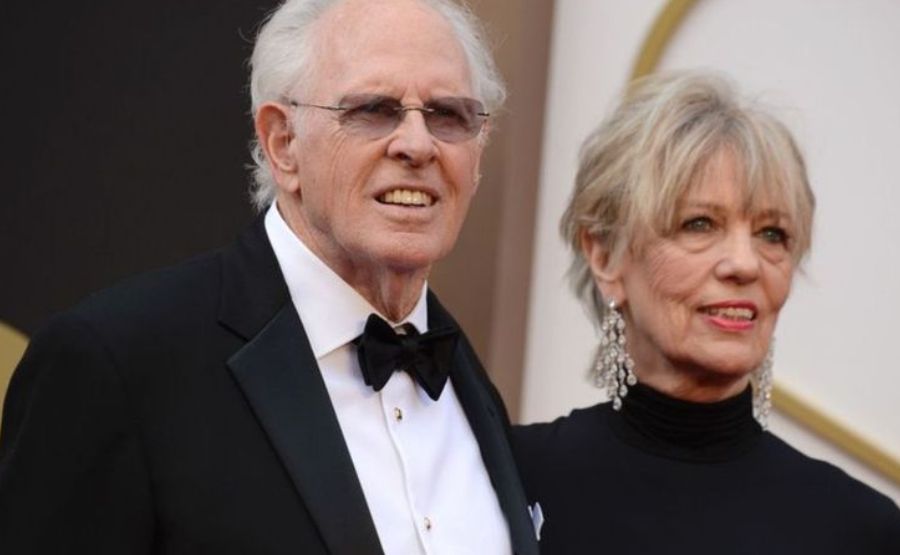
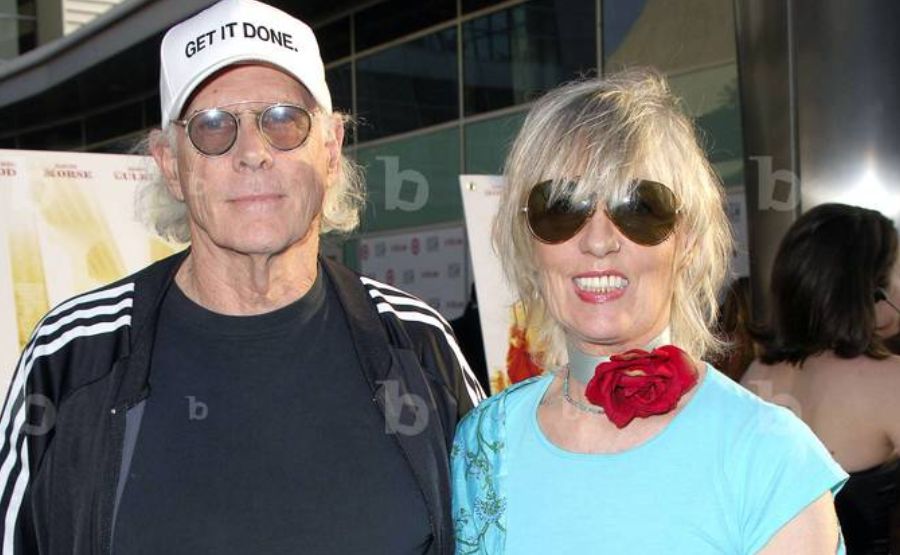
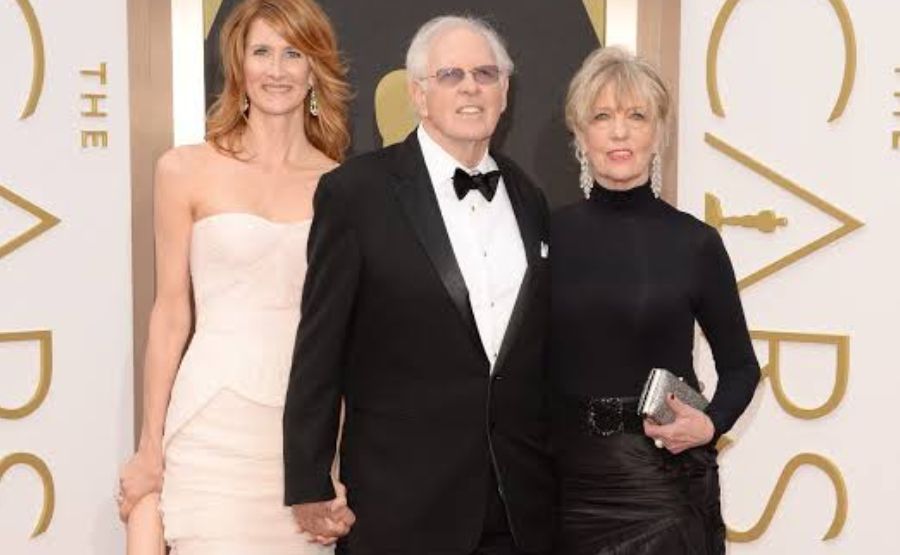
Andrea Beckett has not granted interviews. She does not maintain a public social media presence. She appears on red carpets rarely, and when she does, she stands beside her husband without performing for the cameras.
In an industry built on visibility — where marriages are announced through publicists, where spouses become brands, where even grief is staged for Instagram — Beckett’s consistent withdrawal from that machinery is not passive. It is active. It is a choice made repeatedly, over decades, in a city that rewards exposure above almost everything else.
What makes that choice significant is not its rarity, though it is rare. It is the sustainability of it. Fifty-five years of marriage to one of Hollywood’s most recognized character actors, and virtually no tabloid record. No scandals reported, no feuds publicized, no memoir sold to explain herself. That silence reads, ultimately, as a form of authority.
There is something in her story that echoes the lives of other women who married famous artists and then quietly built their own creative identities apart from the fame: the visual artists, the photographers, the writers who worked in the margins of enormous celebrity and refused to let those margins become their whole address.
The Dern Family and the Complexity of Becoming a Stepmother
When Andrea Beckett married Bruce Dern in October 1969, she stepped into a family that already carried considerable weight. Laura Dern, Bruce’s daughter with Diane Ladd, was two years old. The situation involved not just a new marriage but the ongoing presence of Bruce’s ex-wife — herself a working actress with a significant career — and a small child who would eventually become one of American cinema’s most decorated performers.
Andrea Beckett and Bruce Dern never had children together. The reasons are not publicly documented. But Andrea’s role in Laura Dern’s life, and the broader family dynamic, has remained largely uncontested and undramatic across five-plus decades. That itself is noteworthy. Blended Hollywood families often produce friction that becomes public. The Dern family, under Andrea’s influence, appears to have produced something steadier.
Laura Dern went on to win an Academy Award for Best Supporting Actress for Marriage Story in 2020, and has built one of the most respected careers in contemporary Hollywood. Andrea was present for the decades of work that led to that achievement — not in front of the cameras that documented it, but in the domestic architecture around it.
The Question of Recognition
There is a persistent and slightly uncomfortable question embedded in any biography of Andrea Beckett: Does she deserve a biography at all?
She would likely say no, or at least shrug at the premise. She is not a public figure in any traditional sense. She did not run a company, hold office, or produce work for mass audiences. She married a man who became famous, and then she made her own art and decorated other people’s homes and stayed quiet.
But that framing misses something. The 20th century produced enormous numbers of women who were talented, ambitious, and independent before marriage, and who then disappeared into the biographical footnotes of their more famous husbands. Andrea Beckett avoided that fate not through public declaration but through private insistence. She kept making things. She kept earning collectors. She remained, as a matter of quiet fact, herself.
The April 1969 edition of the Long Beach Press-Telegram ran a photograph of her with a caption describing her as one of the newest of film stars. The internet has essentially no filmography for her under any name. Between that caption and the long quiet that followed it, she made a different kind of decision — and then, over fifty-five years, honored it.
What Her Longevity Says About Both of Them
Bruce Dern is a famously intense individual. His acting career was built on playing unstable, dangerous, and unpredictable characters with such conviction that audiences sometimes confused the performance for the person. He killed John Wayne on screen in The Cowboys (1972) and received hate mail for it. He is deeply competitive, famously talkative, and not widely described as easy to live with.
That he has been married to the same woman since 1969 — through the height of his career, through the leaner years, through the late-career renaissance that brought him to Cannes in 2013 for Nebraska and to Quentin Tarantino’s sets for Django Unchained and The Hateful Eight — says something about both of them.
It says something about her steadiness. It says something about her tolerance for the erratic rhythms of an actor’s life. And it says something about what she offered that his previous relationships did not: a grounded, independent partner who did not need the fame to sustain herself, and who was therefore not threatened by its fluctuations.
The wedding was funded by a Z-grade horror film. The marriage outlasted nearly everyone in the room that October day.
Legacy and Influence: The Case for the Invisible Constant
Andrea Beckett’s legacy is not catalogued in the way that legacies usually are. There is no Wikipedia page for her paintings. No gallery retrospective has been announced. No streaming documentary has been commissioned about the woman who has spent over half a century as the stabilizing force behind one of New Hollywood’s most distinctive voices.
But legacy takes forms that resist easy documentation. The art that hangs in Barbra Streisand’s home carries her eye and her hand. The interiors she designed for Hollywood figures reflect a sensibility that was entirely her own. The fifty-five-year marriage to Bruce Dern — a man who was, by his own description, not a simple person to be with — represents a kind of emotional and creative sustenance that produced decades of work from a man who needed to be grounded in order to take flight.
And perhaps most distinctly, her story offers something to readers who encounter it: evidence that a meaningful life does not require an audience. That privacy is not the same as emptiness. That choosing to make art for collectors rather than critics, to support rather than compete, to remain quiet rather than perform — these are not diminishments. They are, in the right hands, a form of power.
Final Words
Andrea Beckett arrived in Hollywood the hard way — from North Dakota, through New York, through personal loss, through a city that eats the unprepared. She did not become a star. She became something rarer: a person who found a way to live authentically inside the orbit of enormous fame without being consumed by it.
The impulse to reduce her story to “Bruce Dern’s wife” misses what is actually interesting about her. She modeled. She lost a husband. She moved cities twice. She studied under one of America’s most demanding acting traditions. She married a difficult man and stayed. She painted, and her paintings were purchased by people who could have bought anyone’s work. She decorated the homes of Hollywood’s most successful people. She turned down the attention that her position could have purchased at any moment.
As she enters her mid-eighties in 2026, the story of Andrea Beckett remains one that Hollywood has not fully figured out how to tell — because it does not fit the templates. It is not a redemption arc. It is not a cautionary tale. It is simply the story of a woman who knew what she wanted, endured what life handed her, and then built something quiet and lasting on the other side of the loss.
That is not a small thing. That may, in fact, be the whole thing.
FAQs
1. Who is Andrea Beckett?
Andrea Beckett is an American former aspiring actress, visual artist, and interior decorator. She is best known publicly as the wife of Hollywood actor Bruce Dern, whom she married on October 20, 1969.
2. Andrea Beckett was born where and when?
She was born in 1941 in North Dakota, USA. The precise day of her birth has not been made public.
3. How did Andrea Beckett meet Bruce Dern?
They met in the summer of 1969 when Beckett enrolled in an acting class that Dern was teaching at the Strasberg Theatre Institute in Los Angeles.
4. When did Andrea Beckett and Bruce Dern get married?
They married on October 20, 1969, in a ceremony presided over by Justice of the Peace Pete Supera.
5. Was Andrea Beckett married before Bruce Dern?
Yes. She married her high school sweetheart while still young. He died in an automobile accident, leaving her widowed at approximately age 24.
6. Do Andrea Beckett and Bruce Dern have children together?
No. They have no biological children together. Bruce Dern has a daughter, actress Laura Dern, from his previous marriage to Diane Ladd.
7. What is Andrea Beckett’s relationship with Laura Dern?
Andrea is Laura Dern’s stepmother. Laura was approximately two years old when Andrea married Bruce Dern in 1969.
8. What was Andrea Beckett’s acting career like?
Her acting career was brief and largely undocumented. She pursued modeling in New York, appearing in magazines and modeling for Bonwit Teller. A 1969 Long Beach Press-Telegram photograph described her as a rising film star, but she has no credited filmography in major entertainment databases.
9. What is Andrea Beckett known for as an artist?
She is a visual artist whose paintings have been collected by notable Hollywood figures including Barbra Streisand, Heather Locklear, and Pierce Brosnan. She has also worked as an interior decorator, designing spaces for Hollywood clients beyond her own homes.
10. Is Andrea Beckett still alive in 2026?
Yes. As of 2026, Andrea Beckett is believed to be alive and in her mid-eighties, continuing to live privately.
11. What was Andrea Beckett’s maiden name?
She used “Beckett” as her stage name, which was her maiden name. Upon marriage, her legal name became Andrea R. Kermott.
12. For what length of time have Bruce Dern and Andrea Beckett been wed?
As of 2026, they have been married for approximately 57 years, making theirs one of the longest marriages in Hollywood history.
13. Did Andrea Beckett ever appear publicly with Bruce Dern?
Yes, on select occasions, including film premieres and award events, though she maintained a deliberately low public profile throughout their marriage.
14. What funded Bruce Dern and Andrea Beckett’s wedding?
According to Dern’s memoir, the money came from his fee for acting in the low-budget horror film The Incredible Two-Headed Transplant (1971).
15. Why is so little publicly known about Andrea Beckett?
By all available evidence, the limited public record reflects her own deliberate preference for privacy. She has not given interviews, maintained public social media accounts, or pursued the kind of public profile that would generate extensive media coverage.
Connecting curious minds with stories that educate, inspire, and inform with The Editorial Times.