Shashank Tripathi: Why does Shashank Tripathi Wear Sunglasses
In an era when American political commentary rewards the loudest, most recognizable voice in the room, Shashank Tripathi has managed the peculiar trick of building a national media career while simultaneously hiding from it.
He sits at the intersection of two of the defining forces in contemporary American politics: the anonymous internet troll who discovers, somewhat to everyone’s surprise, that the public actually enjoys the entertainment value of his trolling; and the veteran political operative whose tactical instincts are too sharp to remain permanently offscreen. The sunglasses are not the story. But they are the most efficient way to tell it.
Quick Bio
| Category | Detail |
| Real name | Shashank Tripathi |
| Online pseudonym | Comfortably Smug |
| Nationality | American |
| Background | Hedge fund analyst; Republican political consultant |
| Education | B.S. in Economics |
| Former employer | Hedge fund with over $5 billion AUM |
| Political role (2012) | Campaign manager for Christopher Wight, Republican candidate for New York’s 12th Congressional District |
| 2012 incident | Spread false Hurricane Sandy information on Twitter; resigned from campaign; issued public apology |
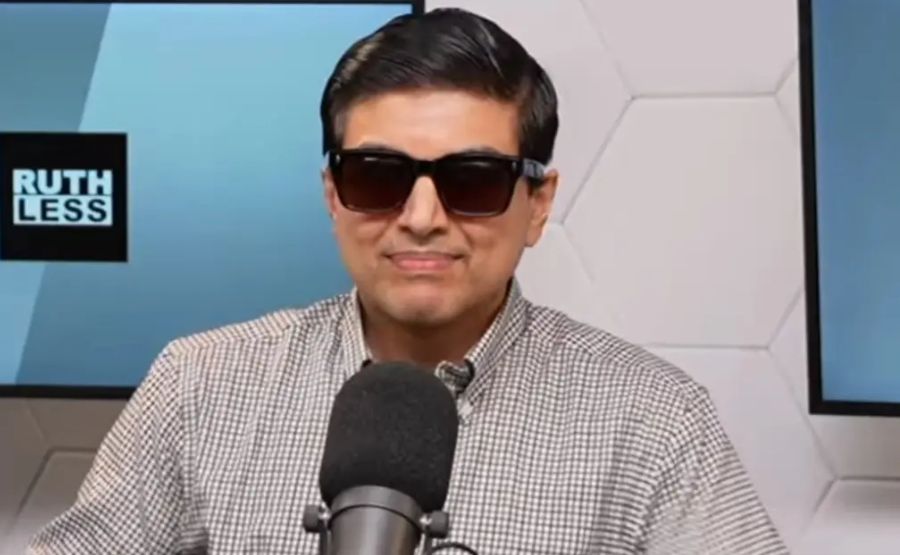
| Podcast | Ruthless — co-hosted with Josh Holmes, Michael Duncan, and John Ashbrook |
| Podcast launch | 2020, in the weeks before the presidential election |
| Co-hosts’ firm | Cavalry (conservative public relations) |
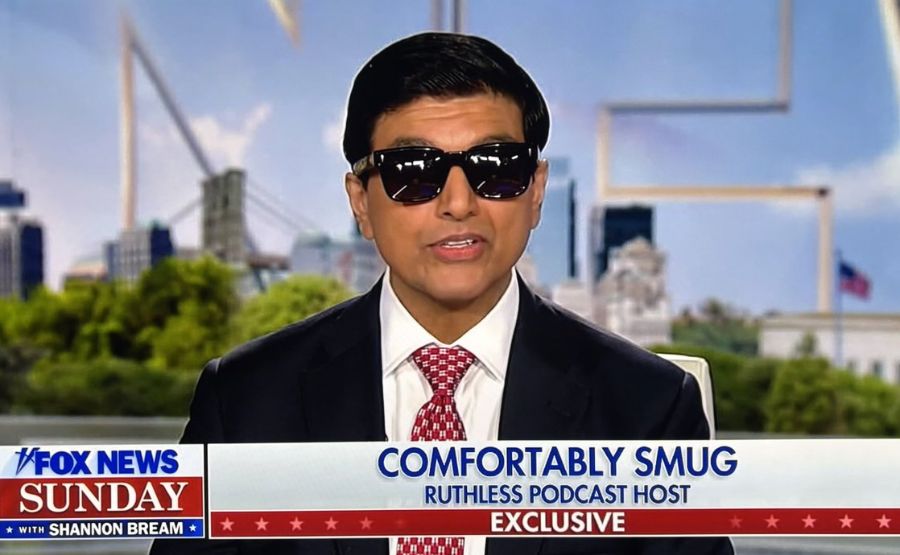
| Media milestones | Appeared on CNN’s Inside Politics with Dana Bash (February 2024); Fox News Sunday with Shannon Bream; Jesse Watters Primetime |
| Fox News deal | July 2025 — Ruthless signed a licensing agreement with Fox News Media |
| Signature look | Wraparound dark sunglasses, worn at all times during appearances |
| Confirmed reason for glasses | Personal discomfort seeing himself on monitors; studio lighting; no full public statement given |
| Personal life | Married; wife’s identity not publicly disclosed |
| Known writing | Contributed to New York Magazine (2008–2009); writing quoted in Wall Street Journal |
From New York Finance to Anonymous Trolling: The First Career
Before he was a podcast celebrity in wraparound sunglasses, Shashank Tripathi was working a desk at a New York hedge fund managing assets in excess of five billion dollars.
That detail is important. He was not a disaffected teenager posting chaos from his bedroom. He was a credentialed, professionally embedded participant in the financial system — a man with a B.S. in Economics who understood how markets moved and what information could disturb them. He also happened to be funny online, in the sharp, contemptuous register that late 2000s Twitter rewarded.
He created the Comfortably Smug account and built an audience within what was then a relatively small, tight world: the pseudonymous New York finance-and-media Twitter set, where anonymity was considered a feature rather than a bug. His writing for New York Magazine, including a 2008 sex diary written when he was 25, gave him a small public profile with his eyes deliberately blacked out in the accompanying photograph. He understood, even then, that keeping his name separate from his persona was both strategic and preferable.
See also “Teresa Barrick Now: The Designer Who Shaped a Rock Legend — and Then Quietly Walked Away“
October 2012: Hurricane Sandy and the Hoax That Changed Everything
On October 29, 2012, Hurricane Sandy made landfall along the Northeast coast of the United States. What followed was one of the most significant natural disasters in New York City’s modern history — and, within hours, one of the most instructive early examples of social media’s ability to spread damaging misinformation during a crisis.
Tripathi, posting as Comfortably Smug, used the chaos of the storm to publish a series of fabricated claims. He wrote that the floor of the New York Stock Exchange was submerged under more than three feet of floodwater. He wrote that Con Edison had shut off all electricity in Manhattan. He wrote that the subway system would be offline for an entire week.
None of these claims were true at the time he posted them. All of them spread rapidly. The NYSE flooding claim reached CNN’s on-air broadcasts before the exchange issued a correction. Con Edison had to publicly deny the shutdown report. BuzzFeed journalist Jack Stuef later documented how the false tweets moved from Smug’s account into television newscasts before corrections could catch up.
Stuef then did something that would permanently alter Tripathi’s life: he identified him. The forensic investigation connected the anonymous account to a 29-year-old hedge fund analyst who was also, at that moment, serving as the campaign manager for Christopher Wight, a Republican candidate challenging Congresswoman Carolyn Maloney in New York’s 12th Congressional District.
The revelation arrived with the specific force of a compound scandal. It was not merely that someone had spread misinformation during a dangerous storm. It was that the person doing it was a professional operative managing a political campaign under his own name, simultaneously posting fabrications anonymously from behind a pseudonym.
Tripathi resigned from the Wight campaign within 24 hours. He issued a written apology describing his tweets as “irresponsible and inaccurate” and taking, in his own words, “full responsibility.” New York City Councilman Peter Vallone publicly requested that the Manhattan District Attorney’s office consider criminal charges for reckless endangerment; legal experts noted that the bar for prosecuting speech acts in this context was very high, and no charges were filed.
In the general election, Wight was defeated by Maloney.
The Disappearance and the Return: How Smug Survived the Unmasking
Being publicly exposed in a national news cycle in 2012 would end most anonymous internet careers. It did not end Comfortably Smug.
Tripathi went into a self-imposed Twitter silence after the unmasking, staying off the platform until March 2013 — a period of roughly five months. When he returned, he came back to a smaller but fiercely loyal audience: the pseudonymous finance accounts and political observers who had been his original community.
The Daily Dot’s 2020 profile of the account traced this trajectory in detail, noting that the Smug persona emerged from the Sandy scandal not fully rehabilitated but arguably more interesting to its core audience. In certain corners of conservative Twitter, the willingness to court controversy, suffer the consequences, and return anyway functions as a form of credentialing. Tripathi’s resilience served him better than contrition would have.
He also shifted terrain. The hedge fund work receded from his public identity. The political commentary deepened. By the late 2010s, he was a fixture in the expanding ecosystem of conservative digital media — not as a journalist, not as an elected official, but as something harder to categorize: an entertainer with real access, a troll with genuine Washington relationships, a provocateur who happened to know how McConnell’s Senate operated from the inside.
Ruthless: The Podcast That Made the Sunglasses Famous
In September 2020, just days after the death of Supreme Court Justice Ruth Bader Ginsburg, the Ruthless podcast launched. The timing would later generate speculation about whether the name was a pointed reference to the late justice’s nickname; the hosts have denied this, saying it referred simply to their editorial approach.
The co-hosts were a specific and deliberate combination. Josh Holmes had served as Mitch McConnell’s chief of staff. Michael Duncan was a veteran GOP communications strategist. John Ashbrook was their partner at Cavalry, a conservative public relations firm. And Tripathi — Comfortably Smug — was the chaos engine, the designated provocateur, the host whose name alone guaranteed that the podcast would attract controversy alongside its audience.
The show’s format positioned politics as entertainment without apologising for that choice. Within its first year, it had hosted eight U.S. senators, three representatives, one sitting governor, and multiple presidential aspirants from the Republican Party, according to reporting in The Guardian. That access was not incidental. It was the product of Holmes’s relationships, Duncan’s credibility, and Ashbrook’s institutional connections — with Tripathi providing the cultural energy that drew audiences beyond traditional political junkies.
The show’s chemistry worked precisely because of its contradictions. Three veterans of formal Washington political infrastructure sat across from a man whose most infamous moment had been spreading misinformation from behind an anonymous account. The tension between institutional legitimacy and digital chaos was built into the premise every episode.
The Sunglasses: Every Reason That Has Been Offered
Shashank Tripathi has never delivered a complete, official public statement on why he wears dark wraparound sunglasses during every recorded and televised appearance. What exists is a scattered collection of partial explanations, secondhand reporting, and educated inference. Each piece of evidence illuminates a different dimension of the same answer.
The practical explanation. During one on-air segment, Tripathi mentioned that he finds it uncomfortable to make eye contact with his own reflection on the monitors present in recording studios. In the era of video podcasting and remote television appearances, creators are constantly confronted with a live image of themselves, which can create a disruptive feedback loop of self-consciousness. The glasses, he suggested, break that loop and allow him to stay present in the conversation rather than watching himself have it.
Studio lighting also plays a role. Professional broadcast setups use high-intensity lights to produce clean video. For people with light sensitivity or simply for those who find extended bright light uncomfortable, sunglasses in a studio environment provide a genuine functional benefit that has nothing to do with branding or mystique.
The post-scandal identity explanation. This one requires more unpacking, but it is arguably the most substantive.
Before October 2012, Comfortably Smug was anonymous. The sunglasses did not exist as a public feature — there was no public appearance to accessorise. The person posting was invisible, and that invisibility was the entire structure of the persona’s appeal. Anonymous accounts derive their character from the gap between what they say and who is saying it. The reader fills in a personality; the account can be bolder, sharper, less constrained precisely because there are no physical consequences attached to the words.
BuzzFeed’s unmasking in 2012 destroyed that structure completely. Suddenly Shashank Tripathi’s actual face, his employer, his political affiliation, and his legal name were all public. The gap collapsed. The anonymous account became a named man with documented actions.
When Tripathi re-entered public life years later, building a new media career as a named and visible figure, he faced a genuine identity problem: how do you reconstruct a persona that existed specifically because it had no face, after the face has been involuntarily revealed? The sunglasses are, in this reading, the answer that emerged. They cannot restore the original anonymity — the name Shashank Tripathi is not secret — but they create a partial barrier between the audience and the person. They preserve one layer of the separation that defined the account’s original appeal.
The brand and character explanation. Political commentary, particularly in its podcast and streaming form, rewards characters as much as it rewards arguments. Viewers subscribe to personalities, to reliable entertainment signatures, to the shorthand of a recognisable look.
The sunglasses have become precisely that shorthand. In professional wrestling terminology — a comparison that has been explicitly applied to the Ruthless format — the sunglasses signal that Tripathi is playing the role of the heel: the villain who is in on the joke, who knows he is the villain, and who weaponises that knowledge. By covering his eyes, he makes himself slightly less readable, slightly less available for the emotional connection that audiences make with sympathetic figures. The sunglasses say: I am the character, not the man. Take the character seriously; the man is not here right now.
The simple vanity explanation. A tweet from the account Bad Fox Graphics, published in September 2025 after a Fox News Sunday appearance with anchor Shannon Bream, offered a different claim: that Tripathi wears sunglasses indoors because he thinks he looks awkward without them. This explanation, delivered with editorial scepticism by a critic rather than confirmed by Tripathi himself, is nonetheless not implausible. Self-consciousness about one’s appearance on screen is a normal and common experience
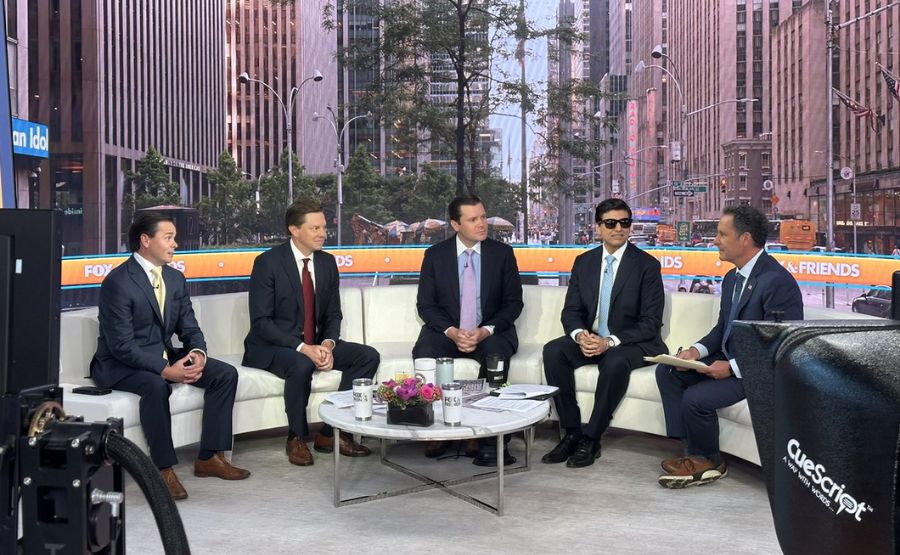
Dana Bash, CNN, and the Sunglasses Becoming National News
On February 29, 2024, Dana Bash hosted the Ruthless team on Inside Politics, ostensibly to discuss Mitch McConnell’s announcement that he would step down from Senate Republican leadership. It was a legitimate news hook for people with authentic access to McConnell’s inner circle.
The segment generated two different sets of headlines simultaneously. For audiences focused on GOP politics, it was a substantive conversation about the future of Senate Republican leadership. For media critics and liberal observers, it was a controversy about CNN’s decision to platform a man whose name had been attached to storm-crisis misinformation twelve years earlier.
Bash closed the segment by turning to Tripathi and gently needling him. “Smug? That’s your — I’m guessing your parents didn’t give you that name,” she said. He replied that the name made him and everyone else happy. She then noted they were out of time before she could discuss the sunglasses, and invited him back specifically for that conversation.
Tripathi did not remove them. He did not discuss them. He had more to say about Mitch McConnell’s legacy than about his eyewear, and so did everyone else in the room.
That unresolved exchange captured something true about how sunglasses function in public. They create a question that the wearer declines to fully answer, which means the question recurs at every subsequent appearance, building a small but durable layer of mystique around what might otherwise be a simple accessory.
The Fox News Deal: Mainstream Arrival, Surviving Scandal
In July 2025, Fox News Media CEO Suzanne Scott announced a licensing agreement with Ruthless. The deal formalized what the podcast’s trajectory had already suggested: that a show co-hosted by a man whose most notable pre-podcast moment was spreading hurricane misinformation could, given sufficient time and the right political environment, achieve mainstream distribution.
The July 2025 Fox News deal placed Tripathi in a setting where his sunglasses were no longer a novelty requiring explanation. They were simply part of the established visual vocabulary of a show with national reach.
Critics noted the circularity. A man who had been exposed as the source of false information spread during a crisis had constructed a second career largely based on criticising legacy media’s relationship with truth. His supporters noted that twelve years is a long time, that the apology was real, and that his audience was large.
Both observations are accurate. Neither cancels the other.
Personal Life: What Tripathi Has Kept Private
Shashank Tripathi is married. He has not publicly disclosed his wife’s name, her profession, or any details of their domestic life. In relation to his media presence, there are no pictures of her.
This privacy is consistent with a pattern that predates the sunglasses. His early internet writing used a pseudonym. His New York Magazine photograph had his eyes blacked out. His most significant pre-podcast public identity was an anonymous Twitter account. The sunglasses are the latest expression of a disposition that has been present throughout his adult life: a preference for engaging publicly while protecting what remains personally available only to those who know him outside the screen.
That disposition coexists, without apparent contradiction, with a very public career. He appears on Fox News. He records video podcasts. He has been photographed by news organisations. He is, by any measure, a public figure. The question of what privacy means when you are simultaneously recognisable and concealed is one that the sunglasses pose every time someone sees them, without the wearer being obligated to resolve it.
Legacy: What the Sunglasses Have Actually Built
Shashank Tripathi’s cultural footprint is modest but distinctive. He did not invent political podcasting. He did not originate the style of conservative commentary that Ruthless represents. He did not break any political stories that changed the direction of national events.
What he did was demonstrate something useful about how American media operates in the social media era. An anonymous account, unmasked after a genuine scandal, going dark for five months and then returning to find that its audience had waited — that is not an obvious outcome. It suggests that audiences attach to voice and attitude as much as, perhaps more than, to credibility in the traditional journalistic sense.
The sunglasses are the physical evidence of that dynamic. They are the mark of a persona that survived the destruction of the conditions that created it, reappearing in a new form that acknowledges the destruction while refusing to be defined by it.
Whether that represents resilience or accountability’s failure is a judgment each audience member makes individually. The sunglasses ensure that Tripathi himself never has to make it publicly.
Final Words
Shashank Tripathi is not a simple figure, and the sunglasses are not a simple detail.
He spread misinformation during a natural disaster that killed hundreds and displaced thousands. He apologised for it, resigned from the role that made the scandal newsworthy, and then — rather than disappearing or fully reinventing himself — simply waited. The internet moved on. His audience reconstituted. A podcast emerged. Fox News came calling.
The sunglasses live somewhere in the gap between those two facts. They are part practical (studio lights, monitor discomfort), part psychological (a man who knows he looks different with a visual barrier between himself and his audience), and part historical (a person who lost his anonymity involuntarily and has spent years constructing a physical substitute for it).
They have not hurt him. They have, if anything, helped him by generating curiosity that keeps his name in circulation and positions him as a figure worth discussing even when the political topic of any given day does not particularly require his perspective.
Dana Bash said she would invite him back to discuss the sunglasses. He has not confirmed that he has returned to do so. The glasses remain on. The question remains open.
That is, one suspects, precisely how Shashank Tripathi prefers it.
FAQs
1. Who is Shashank Tripathi?
Shashank Tripathi is an American Republican political consultant and former hedge fund analyst, known publicly by his online pseudonym Comfortably Smug. He co-hosts the conservative podcast Ruthless with Josh Holmes, Michael Duncan, and John Ashbrook, and is recognisable for wearing dark wraparound sunglasses in all public appearances.
2. Why does Shashank Tripathi wear sunglasses?
He has never issued a single comprehensive explanation. The reasons documented across various sources include: discomfort looking at his own image on studio monitors (stated by him in at least one segment), sensitivity to intense studio lighting, and — according to a critical tweet from Bad Fox Graphics — his belief that he looks awkward without them. Analysts also connect the glasses to the 2012 loss of his online anonymity and to deliberate persona-building.
3. Has Shashank Tripathi ever publicly explained the sunglasses?
No full statement exists. He briefly mentioned the self-monitor issue on one occasion. CNN’s Dana Bash tried to prompt an explanation on air in February 2024 and ran out of time before he responded. He has allowed the question to remain open.
4. What happened during Hurricane Sandy in 2012?
In October 2012, Tripathi posted a series of false claims to Twitter under the Comfortably Smug account, including that the New York Stock Exchange trading floor was flooded, that Con Edison had shut off all power in Manhattan, and that the subway would be closed for a week. These claims spread to television broadcasts before corrections could catch them. He was unmasked by BuzzFeed journalist Jack Stuef, resigned from the political campaign he was managing, and issued a public apology.
5. Did Shashank Tripathi face legal consequences for the 2012 tweets?
New York City Councilman Peter Vallone requested that the Manhattan District Attorney investigate potential criminal charges for reckless endangerment. Legal experts at the time noted the high burden for prosecuting speech in that context. No charges were filed.
6. What is the Ruthless podcast?
A conservative political podcast that launched in September 2020, co-hosted by Tripathi, Josh Holmes (former chief of staff to Mitch McConnell), Michael Duncan (GOP communications strategist), and John Ashbrook. Holmes, Duncan, and Ashbrook are partners at the conservative PR firm Cavalry. The show combines political analysis with an entertainment-forward format.
7. What was the Fox News deal?
In July 2025, Fox News Media announced a licensing agreement with Ruthless, formalising the show’s relationship with the network and significantly expanding its distribution. CEO Suzanne Scott described it as a natural extension of Fox News’s brand into the podcast space.
8. Who are Tripathi’s co-hosts on Ruthless?
Josh Holmes, who served as Mitch McConnell’s chief of staff; Michael Duncan, a longtime Republican communications strategist; and John Ashbrook. All three are partners at the PR firm Cavalry. Tripathi operates primarily under his online pseudonym within the podcast and its associated media appearances.
9. Why did critics object to CNN having Tripathi on air?
Because his most notable pre-podcast public action was deliberately spreading false information during a dangerous storm. Critics argued that hosting him under his pseudonym without fully acknowledging that history presented an incomplete picture to viewers unfamiliar with his 2012 record.
10. Is Shashank Tripathi the same person as Chuck Berry’s son or any other notable Berry?
No. The Shashank Tripathi and Chuck Berry association does not exist. Some confusion occurs because another person named David Muir’s wife “Rebecca” has generated similar SEO-driven false content in unrelated searches. Tripathi’s last name is not Berry; he is a distinct individual.
11. When did Comfortably Smug return to Twitter after the 2012 scandal?
According to Daily Dot’s 2020 profile, Tripathi returned to Twitter in March 2013, approximately five months after the October 2012 unmasking and apology.
12. Does Tripathi discuss his personal life publicly?
Almost not at all. He is married but has not disclosed his wife’s name, identity, or any details of his private domestic life. His public persona maintains the same structural separation from personal information that his anonymous Twitter account originally provided.
13. What was Tripathi’s background before the Sandy incident?
He worked as a hedge fund analyst at a firm managing over five billion dollars in assets. He held a B.S. in Economics, contributed writing to New York Magazine, and had been building the Comfortably Smug online persona since at least the late 2000s, when his writing was quoted in the Wall Street Journal.
14. What did Dana Bash say about the sunglasses on CNN?
At the close of the February 29, 2024 Inside Politics segment, Bash told Tripathi they were running out of time but that he would need to return for “a discussion about the sunglasses.” She did not receive an explanation on air.
15. Has the sunglasses question ever been fully resolved?
No. As of available reporting through mid-2025, Tripathi has not given a full, direct public explanation. The glasses remain a consistent feature of every appearance, and the unanswered question around them continues to generate search interest and occasional media commentary.
Connecting curious minds with stories that educate, inspire, and inform with The Editorial Times.