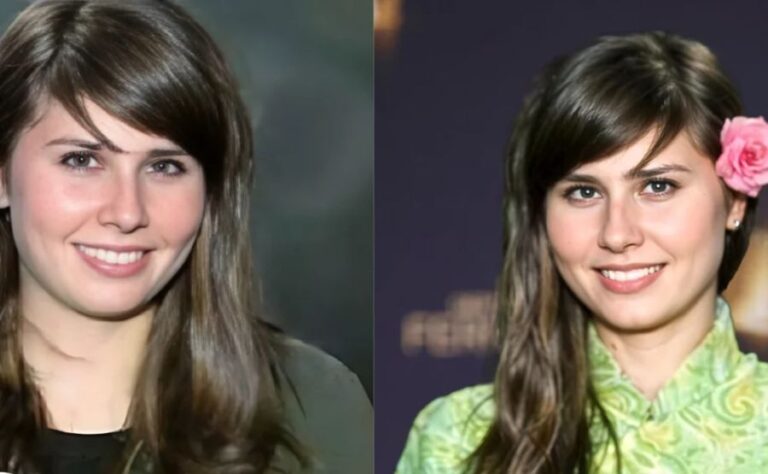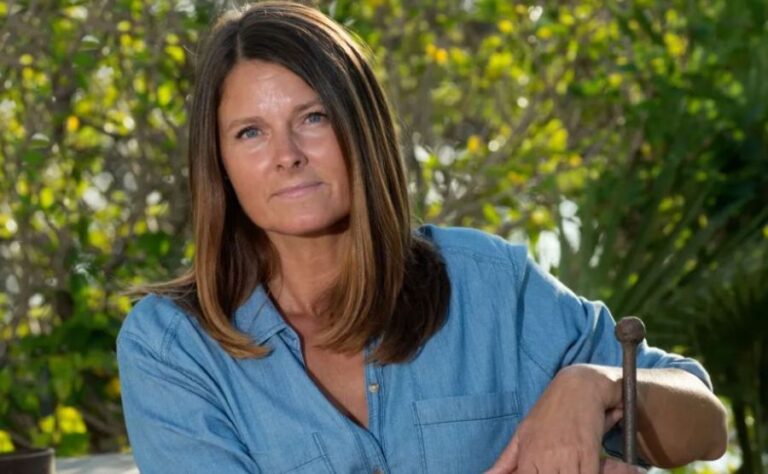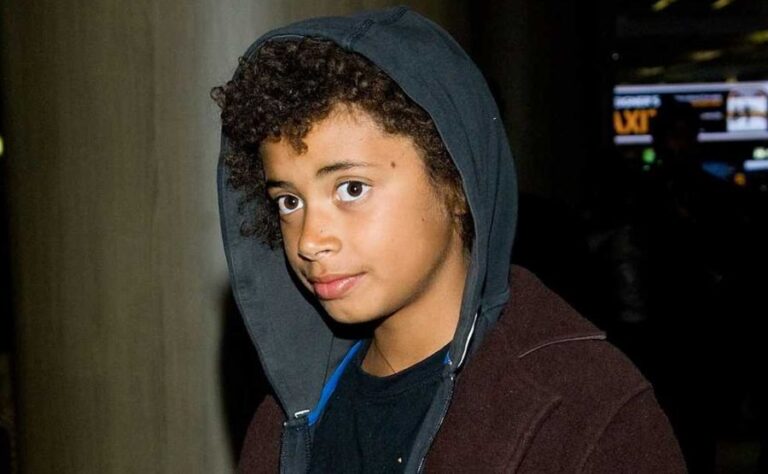
Caroline Crowther: The Quiet Force Behind Two Legacies
She never sought a spotlight, yet her life sits at the precise intersection of Britain’s most beloved comedian and Ireland’s greatest rock poet — and in that position, she absorbed more grief, more love, and more reinvention than most people encounter in a lifetime.
Quick Facts
| Detail | Information |
| Full Birth Name | Caroline Susan Crowther |
| Date of Birth | December 9, 1958 (per official Companies House records; some sources cite 1954) |
| Nationality | British |
| Father | Leslie Crowther CBE — comedian, actor, television presenter |
| Mother | Jean Elizabeth Stone Crowther |
| Siblings | Twin sister Liz Crowther (actress); sisters Lindsey and Charlotte Crowther; brother Nick Crowther |
| Spouse (1st) | Phil Lynott (married February 14, 1980; separated 1984; never formally divorced) |
| Spouse (2nd) | David James Taraskevics (date undisclosed; now known as Caroline Taraskevics) |
| Children | Sarah Lynott (born December 19, 1978); Cathleen Lynott (born July 29, 1980) |
| Career | Music public relations (Tony Brainsby PR); Thin Lizzy estate management (directorial roles) |
| Current Residence | Bristol, United Kingdom |
| Documentary Appearance | Songs for While I’m Away (2020), credited as Caroline Taraskevics |
| Connection to Rock History | Wife of Thin Lizzy frontman Phil Lynott; subject of songs “Sarah” (1979) and “Cathleen” (1982) |
Born Into the Spotlight She Never Wanted
Leslie Crowther was already a household name in Britain by the time his daughter Caroline arrived on December 9, 1958. Her father had built a television career stretching back to BBC children’s programming in the 1950s, and his warm face was as familiar to British audiences as a next-door neighbour’s.
Growing up with that kind of fame in the living room produces one of two outcomes. Either a child reaches hungrily toward the cameras, or they quietly turn in the other direction. Caroline chose the latter — decisively, and for good.
She was born the daughter of a man who would go on to host Crackerjack from 1960 to 1968 and later host the original British run of The Price Is Right from 1984 to 1988, coining the enduring catchphrase “Come on down!” Yet despite the theatrical genetics on both sides — her grandfather was an actor, her grandmother one of Britain’s first female stage directors — Caroline showed no appetite for performance. She watched her father work and chose a life backstage.
Her twin sister Liz became an actress. Her brother Nick went into radio. Caroline went into public relations.
See also “How Old is Ruby Wax: The Comic Who Chose Truth Over the Punchline“
The PR Office That Changed Everything
In the late 1970s, Caroline Crowther took a job with Tony Brainsby, one of London’s most prominent music publicists. Brainsby’s firm handled some of the era’s biggest rock acts, and his office was a daily flow of artists, managers, and the particular electricity that surrounds successful bands.
Thin Lizzy was on the firm’s roster.
Caroline’s first contact with Phil Lynott was by telephone. He would call into the office, and she would answer. Something about his voice — deep, measured, unexpectedly tender for a hard rock frontman — lodged in her imagination before she ever saw his face. She later said, in the 2020 documentary Songs for While I’m Away, that she was already partly in love with him before they had physically met.
Then she saw Thin Lizzy perform live at the Hammersmith Odeon in London. That ended any remaining ambiguity. She was, as she told the documentary’s director Emer Reynolds, “hooked.”
What followed was one of the more unlikely love stories in British pop culture: a comedian’s daughter and a working-class poet from Dublin, brought together by a publicist’s phone line.
Valentine’s Day and Howth
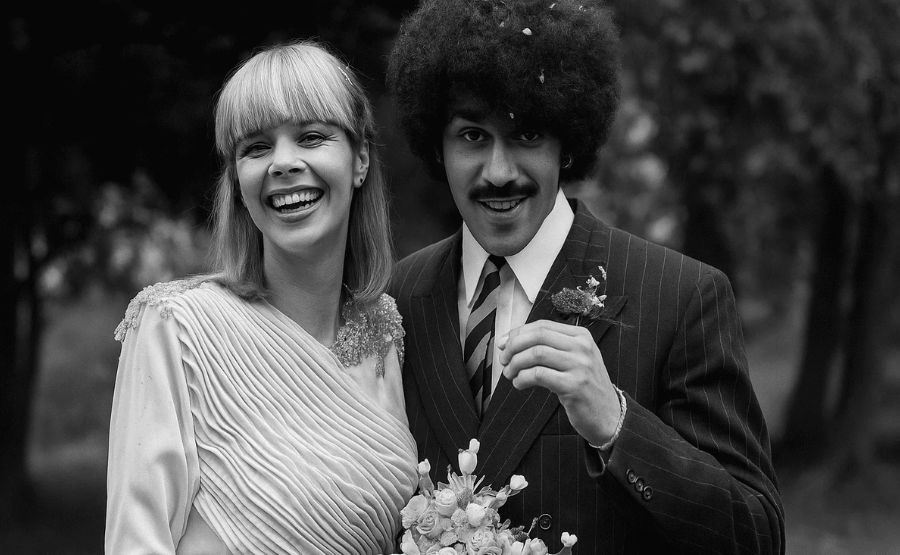
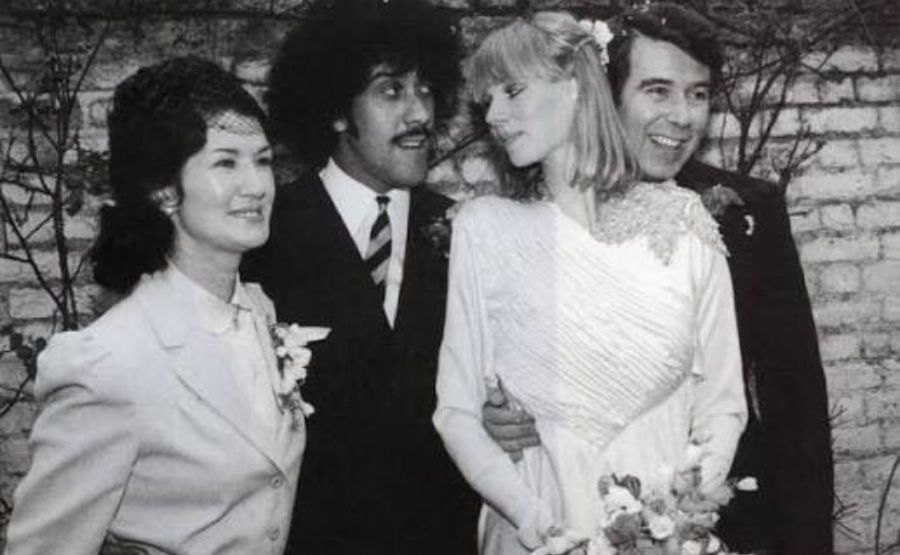
Phil Lynott and Caroline Crowther married on February 14, 1980 — Valentine’s Day — in Richmond, Surrey. The date was not accidental. Lynott, who wrote poetry as fluently as he wrote bass lines, understood symbolism. The wedding represented a collision of two entirely different entertainment worlds: British television heritage meeting Irish rock royalty.
The couple made their primary home in Howth, a small fishing village on the northeast coast of Dublin Bay. Phil had purchased a house there for the family, and for a time, they inhabited something resembling domestic normalcy. Their first daughter, Sarah, had already arrived on December 19, 1978 — before the wedding — and Cathleen followed on July 29, 1980.
Phil immortalised both daughters in music. The song “Sarah,” released in 1979, became one of the most tender compositions in Thin Lizzy’s catalogue — a piece of songwriting that stripped away the band’s harder edges to reveal a man quietly overwhelmed by fatherhood. “Cathleen,” a solo track released in 1982, carried a similar emotional weight.
While the public heard a rock icon, Caroline witnessed a man who was genuinely shaken by love for his children. “He was a very, very complex person who could constantly surprise you,” she told the Songs for While I’m Away documentary. “He had a big heart, was a dreamer, and was shy. He was delicate”.
The Architecture of a Rock Marriage
Being married to Phil Lynott in his prime was not a simple arrangement. Thin Lizzy was a global touring force through the late 1970s and into the early 1980s. Albums like Jailbreak (1976), Bad Reputation (1977), Black Rose: A Rock Legend (1979), and the legendary live record Live and Dangerous (1978) had cemented the band’s reputation as one of rock’s most electrifying live acts.
That success meant months of absence. It meant a home in Howth where the father’s bedroom was often empty. Caroline managed the daily rhythms of two young children while her husband existed between tour buses, hotels, and recording studios.
She was not, by any account, the sort of celebrity spouse who attended every party and lingered in the background of every photograph. She kept away from the tabloid circuit. While Lynott’s charisma drew cameras wherever he went, Caroline remained largely invisible — by design, not by accident.
The contradiction of their marriage was built into its foundations. Phil Lynott was a man constitutionally unsuited to stillness; Caroline Crowther was a woman constitutionally unsuited to spectacle. For a few years, those opposing qualities held the marriage in a kind of productive tension.
Addiction, Divorce, and the Unsalvageable Marriage
By the early 1980s, Thin Lizzy began its decline. Personnel changes, the brutal pace of sustained touring, and the pressures of commercial expectation ground the band down. The band formally disbanded in 1984 after the Thunder and Lightning tour — but long before that, something darker had taken root in Phil Lynott’s private life.
Heroin and alcohol had become constants. The addiction that would eventually kill him grew through the early part of the decade, intensifying as professional certainties fell away. For Caroline, life at home shifted from the manageable frustrations of single-parenting a rock star’s children to something far more frightening.
She tried to hold the family together. She could not.
The marriage effectively collapsed in 1984, directly corresponding with Lynott’s escalating drug use. Critically, the couple never formally divorced. They separated — emotionally, practically, geographically — but remained legally husband and wife at the time of his death.
That legal status would carry its own weight when the end came.
Christmas 1985 and the 100-Mile Drive
On Christmas Day, 1985, Phil Lynott collapsed at his home in Kew, west London. He was discovered by his mother, Philomena, who had no knowledge of the extent of his heroin addiction.
Philomena called Caroline.
Caroline drove over 100 miles from her home in Bath to reach him. She immediately understood what she was looking at — not a sudden illness, but the predictable endpoint of years of substance abuse. She drove him to Clouds House, a drug rehabilitation clinic near Shaftesbury, Dorset. The clinicians there took one look at Lynott’s condition and redirected him immediately to Salisbury Infirmary.
He was diagnosed with septicaemia — blood poisoning — along with damage to his kidneys and liver. For a moment, he was conscious again and talked to his mother. His condition deteriorated sharply in the first days of January. He was placed on a ventilator.
On January 4, 1986, Phil Lynott died of septicaemia-induced pneumonia and heart failure. He was 36 years old.
An account from Classic Rock’s Loudersound described the scene in those final days: Caroline, face etched with worry, sat at his bedside. Beside her, holding her hand tightly, was her father — Leslie Crowther, the television comedian, sitting vigil in a hospital room at the end of his son-in-law’s short life.
Two entertainment dynasties converging in grief around a man who had run out of time.
Personal Life: Loss Upon Loss
The death of Phil Lynott left Caroline at 27 years old with two daughters aged eight and six. Sarah would later say that hearing her father’s song still brought him close; Cathleen described how her own son, Oscar, carries Phil’s jawline and height — genetic memory moving forward through generations.
Caroline did not remain static in the aftermath. She eventually remarried, taking the surname Taraskevics — her husband believed to be David James Taraskevics, though she has kept the details entirely private. She relocated to Bristol, where she raised Sarah and Cathleen away from the Irish coast and the Dublin context of their father’s mythology.
The daughters grew up, by their own accounts, in a grounded environment. Neither sought celebrity status during childhood. Neither was photographed publicly for years. When they did eventually speak to the press — first in an interview with The Irish Sun around 2019, at the launch of a commemorative silver coin marking 70 years since Phil’s birth — they described quiet pride rather than dramatic inheritance.
“Anytime someone would find out who we were,” Cathleen told the paper, “they were always full of awe and pride, and we were always very proud too.”
That composure — neither exploiting nor denying their father’s name — bears the visible imprint of how they were raised.
Caroline also experienced the loss of her father. Leslie Crowther suffered a severe car accident on the M5 motorway in October 1992 that left him in a coma for 17 days with serious head injuries. He never fully returned to television work. He died on September 28 or 29, 1996, at the Royal United Hospital in Bath, aged 63 — with his wife Jean and family at his side. Caroline had already buried her husband. Now she buried her father.
Stewardship of the Thin Lizzy Estate
Caroline Crowther’s post-1986 life is not, as sometimes assumed, entirely one of passive withdrawal. Companies House filings — public official records maintained by the United Kingdom’s company register — list Caroline Susan Taraskevics, born December 1958, as holding multiple directorial and secretarial roles in companies connected to Thin Lizzy’s interests and Phil Lynott’s music catalogue.
This is not ceremonial involvement. It places her within the formal governance structure of a commercially active music estate. Thin Lizzy’s catalogue continues to generate revenue through streaming, licensing, and merchandise. A purposeful curatorial approach is evident in the care with which that legacy has been handled, guaranteeing that the band’s identity stays rooted in Lynott’s artistic vision rather than being diluted by commercial excess.
In 2012, Caroline publicly objected when Thin Lizzy’s music appeared at a United States political event without her family’s consent. That public statement was notable precisely because it was so rare. She intervenes when the estate’s integrity demands it, then retreats back into privacy.
Her daughters have become more publicly active in this stewardship role. Cathleen has held directorial roles in Thin Lizzy-related corporate entities. Both Sarah and Cathleen participated in the 2020 documentary Songs for While I’m Away, directed by Emer Reynolds. In 2012, the remaining members of Thin Lizzy chose to record new material under the name Black Star Riders rather than continue under the Thin Lizzy name — partly because Caroline and the family were uncomfortable with new recordings that did not include Phil. That boundary held, and it defined how subsequent generations would experience the band’s legacy.
The 2020 Documentary: A Rare Window
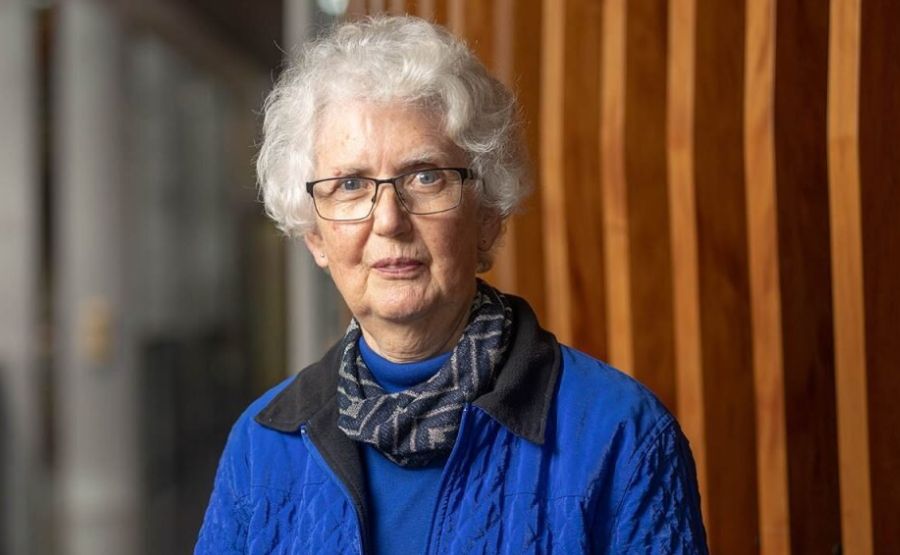
Caroline appeared in Songs for While I’m Away — the critically received 2020 documentary about Phil Lynott’s life — credited on screen as “Caroline Taraskevics, Phil Lynott’s wife.” Her screen time was limited. Her contributions were not.
She described Phil in terms that complicated the rock-rebel mythology: shy, sensitive, a dreamer. She spoke about the complexity of loving someone who contained multitudes — the hard-driving frontman and the tender father, the poet and the addict, the man who called her from a publicist’s office and the man who could not be saved.
Her willingness to participate at all, after thirty-plus years of deliberate silence, said something significant. She was not there to settle scores or claim victimhood. She was there to ensure that the man his daughters remembered — the father who wrote “Sarah” with Gary Moore, who called their names softly into recording microphones — did not get buried entirely beneath the drama of his death.
It was the act of a woman who had decided, quietly and precisely, what Phil Lynott’s story was actually about.
Legacy: What Silence Preserves
There is a version of Caroline Crowther’s life that would have looked entirely different. She could have written a memoir. She could have given decades of interviews. She could have parlayed her connection to two British entertainment dynasties into sustained media presence.
She chose none of that.
The daughters she raised carry Phil Lynott’s name but not his chaos. They are articulate, grounded women who speak of their father with love and of their mother with deep respect. Sarah Lynott built a professional career in event management in England. In order to maintain her father’s business, Cathleen has been involved in estate management. Neither turned into a warning story.
That is Caroline Crowther’s most durable achievement — not a public record or a catalogue of appearances, but two women who emerged intact from an extraordinary and painful inheritance.
The Bristol life she built — the second marriage, the private routines, the distance from rock mythology — is not a retreat. It is a construction. She built it deliberately, with the materials of someone who understood that fame without purpose is exhausting and that privacy, handled properly, is a form of strength.
Final Thoughts
Caroline Crowther occupies one of the stranger positions in twentieth-century British cultural history — not quite central, not quite peripheral, but threaded through two of its most recognizable stories.
Her father gave Britain “Come on down!” Her spouse presented Ireland with “The Boys Are Back in Town.” When the cameras were off, she provided stability, presence, and loyalty to both of them.
What is easy to overlook, in the tendency to define her by her relationships, is that her choices were entirely her own. She chose a career in music PR. She chose Phil Lynott. She chose to drive 100 miles on Christmas night to try to save him. She chose silence afterward. She chose Bristol and remarried and the boardroom of a music estate rather than the front pages of tabloids.
Her life resists tidy summaries because tidy summaries require a person to be passive — swept along by other people’s greatness or tragedy. Caroline Crowther was never passive. She was simply, and deliberately, quiet.
Rock music has always celebrated the people who shout. Caroline Crowther’s contribution is in everything that held together while the shouting happened — and in everything she protected once the shouting stopped.
FAQs
1. Who is Caroline Crowther?
She is the daughter of British comedian and TV presenter Leslie Crowther and the former wife of Thin Lizzy frontman Phil Lynott. She worked in music public relations in the late 1970s before her marriage to Lynott in 1980.
2. When was Caroline Crowther born?
Official UK Companies House records list her birth as December 1958, though some biographical sources cite December 9, 1954. The Companies House date, as a legal document, is generally considered more authoritative.
3. How did Caroline Crowther meet Phil Lynott?
She met him while working at Tony Brainsby’s music publicity firm in London in the late 1970s. Thin Lizzy was a client of the agency, and Lynott would call in regularly. Their first contact was by telephone.
4. When did Caroline and Phil Lynott get married?
They married on February 14, 1980 — Valentine’s Day — in Richmond, Surrey.
5. Did Caroline and Phil Lynott divorce before his death?
No. They separated in 1984 after Lynott’s drug addiction escalated, but they never formally divorced. Caroline was still legally his wife when he died on January 4, 1986.
6. What are the names of Caroline’s children with Phil Lynott?
Their daughters are Sarah Lynott, born December 19, 1978, and Cathleen Lynott, born July 29, 1980. Phil wrote songs named “Sarah” (1979) and “Cathleen” (1982) in their honour.
7. What role did Caroline play in Phil Lynott’s final days?
When Lynott collapsed on Christmas Day 1985 at his home in Kew, his mother Philomena called Caroline, who drove over 100 miles from Bath to reach him. Caroline recognised the severity of his condition and drove him to Clouds House rehabilitation clinic, from which he was transferred to Salisbury Infirmary. He died there on January 4, 1986.
8. Did Caroline Crowther remarry after Phil Lynott’s death?
Yes. She remarried — her second husband believed to be David James Taraskevics — and she is now publicly known as Caroline Taraskevics in professional and legal contexts.
9. Where does Caroline Crowther live today?
She lives in Bristol, United Kingdom, where she relocated after her second marriage. She maintains a very private life with minimal public presence.
10. Has Caroline Crowther ever spoken publicly about Phil Lynott?
Rarely. Her most significant public statements came through her participation in the 2020 documentary Songs for While I’m Away, directed by Emer Reynolds, where she described Lynott as shy, sensitive, and complex — a man of surprising depth beneath the rock-star exterior.
11. Is Caroline Crowther involved with the Thin Lizzy estate?
Yes. UK Companies House records list her (as Caroline Susan Taraskevics) in multiple directorial and secretarial roles connected to Thin Lizzy corporate entities. She was also publicly involved in the 2012 objection when Thin Lizzy’s music was used at a US political event without family consent.
12. What happened to her father Leslie Crowther?
Leslie Crowther was involved in a serious car accident on the M5 motorway in October 1992, sustaining severe head injuries. He never returned to full television work and died of heart failure on September 28/29, 1996, at the Royal United Hospital in Bath, aged 63.
13. Did Leslie Crowther have a close relationship with Phil Lynott?
They were connected through Caroline’s marriage. According to a detailed account in Classic Rock’s Loudersound, Leslie Crowther was present at Phil Lynott’s bedside in Salisbury Infirmary during his final days, holding Caroline’s hand as they kept vigil together.
14. Who are Sarah and Cathleen Lynott today?
Both are adults with children of their own. Sarah has worked in event management in England. Cathleen has held corporate roles connected to the Thin Lizzy estate. Both have spoken publicly about their father, describing pride in his legacy and gratitude for a grounded upbringing.
15. Is Caroline Crowther on Wikipedia?
She does not have a dedicated Wikipedia page. Information about her life appears primarily through entries on Phil Lynott and Leslie Crowther, documentary records, Companies House filings, and the few interviews her daughters have given to the press.
Connecting curious minds with stories that educate, inspire, and inform with The Editorial Times.