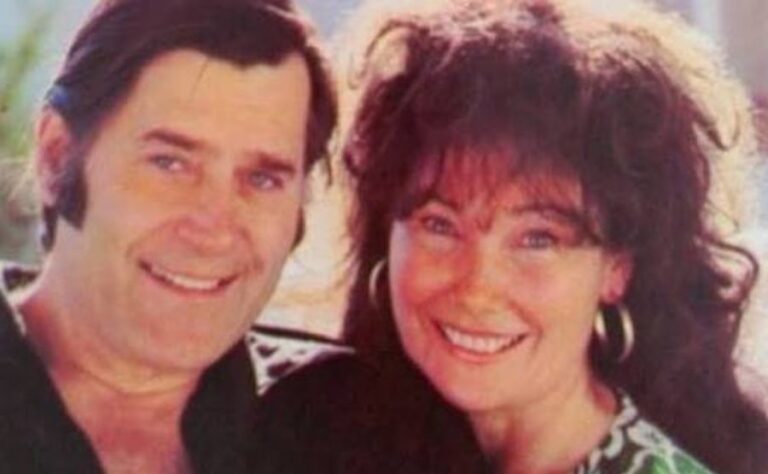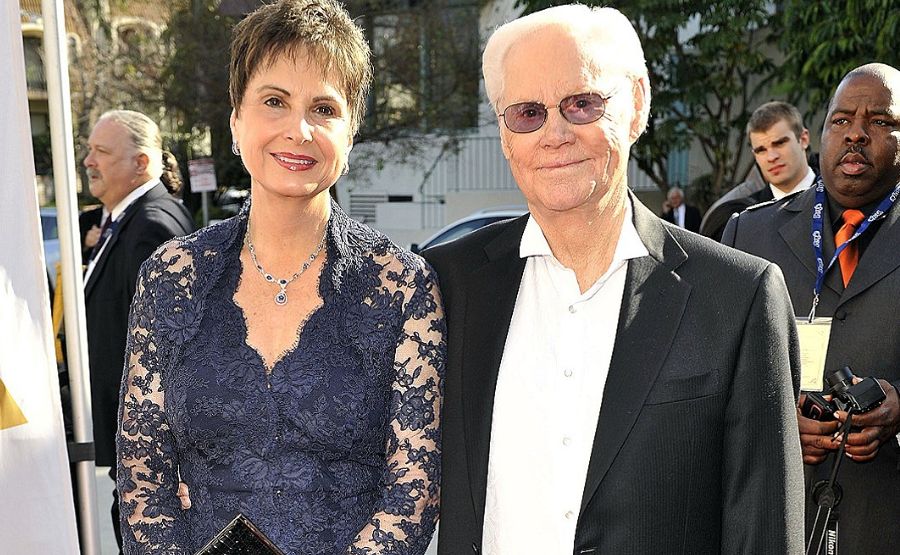
Nancy Sepulvado: The Woman Who Refused to Give Up on George Jones
Nancy Sepulvado walked into a concert in New York in 1981 knowing almost nothing about the man on stage — and spent the next three decades saving his life, rebuilding his career, and ultimately telling the truest version of his story that the world had ever heard.
Quick Bio
| Detail | Information |
| Full Name | Nancy Sepulvado Jones |
| Birth Date | April 6 (birth year disputed: circa 1953 or 1959) |
| Birthplace | Shreveport, Louisiana (some sources cite Mansfield, Louisiana) |
| Nationality | American |
| Occupation | Estate manager, author, legacy curator; former flight attendant |
| Married | George Jones, March 4, 1983 — April 26, 2013 (his death) |
| Marriage Length | 30 years |
| Children | Two daughters from previous marriage (including Adina) |
| Stepchildren | Four (George Jones’s children: Georgette, Bryan, Jeffrey, Susan) |
| Notable Work | Playin’ Possum: My Memories of George Jones (2023, co-authored with Ken Abraham) |
| Key Initiatives | George Jones Museum (Nashville), George Jones Scholarship Fund at MTSU, “Still Playin’ Possum” tribute concert (2023) |
| Current Residence | Woodville, Texas |
| Status | Alive as of 2026 |
The Woman the History Books Skip
Country music has told George Jones‘s story many times. The voice. The whiskey. The missed shows. The genius of “He Stopped Loving Her Today.” What those stories consistently underweight is the woman who made his final decades possible.
Nancy Sepulvado married George Jones on March 4, 1983, in a quiet ceremony at his sister’s home in Woodville, Texas. They toasted their union with dinner at a Burger King. There was nothing cinematic about the beginning. There didn’t need to be.
What followed was thirty years of extraordinary, difficult, sometimes brutal partnership — a story of addiction and abuse and recovery and grace that Nancy finally told herself, in full, in her 2023 memoir Playin’ Possum: My Memories of George Jones. She was not, she made clear, interested in sugarcoating anything.
See also “Devon Minters: The Quiet Man Behind a Famous Daughter’s Strength“
Louisiana Roots and a Life Before the Spotlight
Nancy Sepulvado grew up in Louisiana, most sources pointing to Shreveport as her birthplace, with some accounts naming Mansfield. Both cities sit in the northwestern corner of a state shaped by music, Catholic tradition, and a hospitality culture that values loyalty above most other virtues. That combination of warmth and stubbornness would prove essential.
Her birth year remains genuinely uncertain. Credible sources place it anywhere between 1953 and 1959, a discrepancy that reflects the degree to which Nancy has guarded the details of her private life. She attended school in Louisiana and later studied at the Fashion Institute of New York City, graduating with honors — one of the few confirmed details of her pre-George years.
Before meeting Jones, Nancy worked as a flight attendant. That career placed her in an industry that demands composure under pressure, attentiveness to other people’s needs, and the ability to function inside someone else’s chaotic schedule. She had also been previously married and divorced. She arrived at her famous blind date as a self-sufficient woman who already understood that relationships could fail.
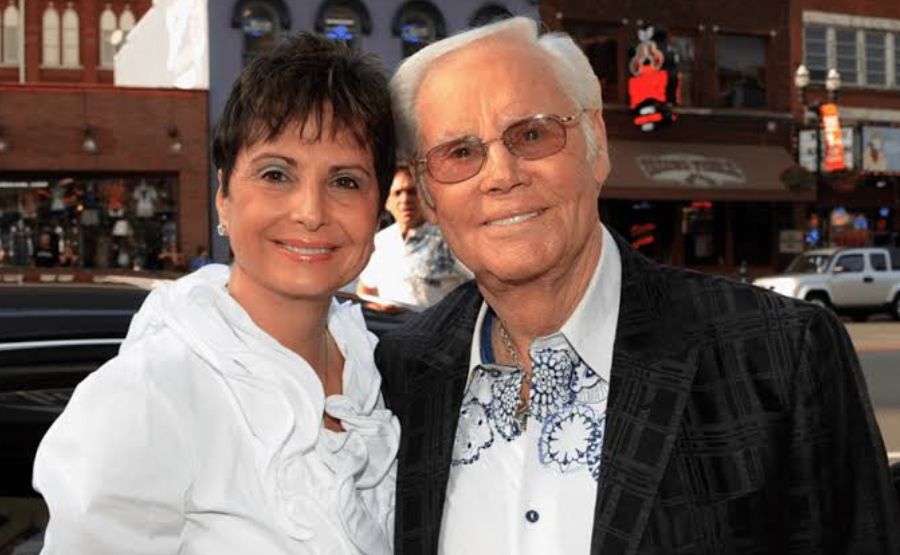
The Night Everything Changed: November 1981
The meeting happened not because Nancy sought George Jones out, but because her friend was dating Jones’s tour manager. They went to his concert in New York together. Nancy had essentially no familiarity with his music.
Then he walked onstage.
She described the moment years later to The Tennessean with the directness that characterizes everything she says: “My God, he walked on stage, and the crowd went wild. And that voice. I thought, ‘How is that coming out of that man’s mouth? Dang, he’s good.'” She became a fan within minutes, but she stayed cautious about the man behind the performance.
She had heard the stories. Jones had earned the nickname “No Show Jones” because he regularly failed to appear at his own concerts — derailed by alcohol and cocaine, burning professional goodwill at a rate that had generated nearly 200 lawsuits against him for missed performances. His three previous marriages — to Dorothy Bonvillion, Shirley Ann Corley, and the legendary Tammy Wynette — had all ended in varying degrees of wreckage.
“I’d heard the horror stories,” Nancy subsequently remarked. “But I’m of the opinion you don’t believe it ’til you see it. I ended up seeing plenty of it, but we just clicked. I saw a lot of good in a man who was being totally destroyed.”
They began dating. Jones would later write in his 1996 autobiography I Lived to Tell It All that no teenage boy ever fell for a girl harder than he fell for Nancy Sepulvado. He wrote that on that November night in 1981, he had no idea she would someday save his life.
March 4, 1983: A Marriage Begins
The wedding took place at the home of Jones’s sister, Helen Scroggins, in Woodville, Texas — the same small East Texas town where Nancy would eventually make her home after Jones’s death. The ceremony was private and modest. The couple’s post-ceremony dinner at Burger King reflected not poverty but a shared indifference to performance.
This was Jones’s fourth marriage and, as the world would later understand, his final one. Nancy entered it as a 34-year-old divorcée with two daughters. She brought organizational intelligence, emotional resilience, and a faith in George Jones’s fundamental worth that would be tested, severely and repeatedly, over the years that followed.
What she could not have fully anticipated — despite the warnings — was the scale of chaos she was inheriting.
The 18-Year Battle: Living Inside Addiction
Nancy has been candid, in interviews and in her memoir, about what the early years of the marriage actually looked like. George Jones’s addiction was not an inconvenience. It was an active, destructive force that shaped every day of their shared life.
She moved quickly. Shortly after the wedding, she fired his manager and his lawyers. She took control of his finances, which were in a genuine crisis. She cut off access to the drug dealers who had established regular relationships with her husband. One reported consequence of those decisions was chilling: according to accounts sourced to the biography George Jones: The Life and Times of a Honky Tonk Legend, dealers kidnapped Nancy’s daughter in retaliation.
While the public saw a reviving country legend gradually getting his act together, Nancy lived a different version of those years. She admitted in Playin’ Possum that she experienced physical abuse from George during the addiction era. “You can’t walk around and say I never got slapped, I never got hit,” she told the Mitmunk publication. She stayed anyway — not out of passivity, but because she believed in the man underneath the destruction.
“Could I have walked away? Sure, many times,” she told Fox News Digital in 2023. “But I knew he wanted to get well, and he couldn’t do it alone.”
In interviews she kept a consistent smile. She managed access, maintained professional relationships, and gave no public indication of what she endured privately. “No one ever knew what I was going through,” she told Americana Highways. “I kept all of that to myself. I always had a smile on my face and acted like everything was just great, and to me, that was the hardest thing ever.”
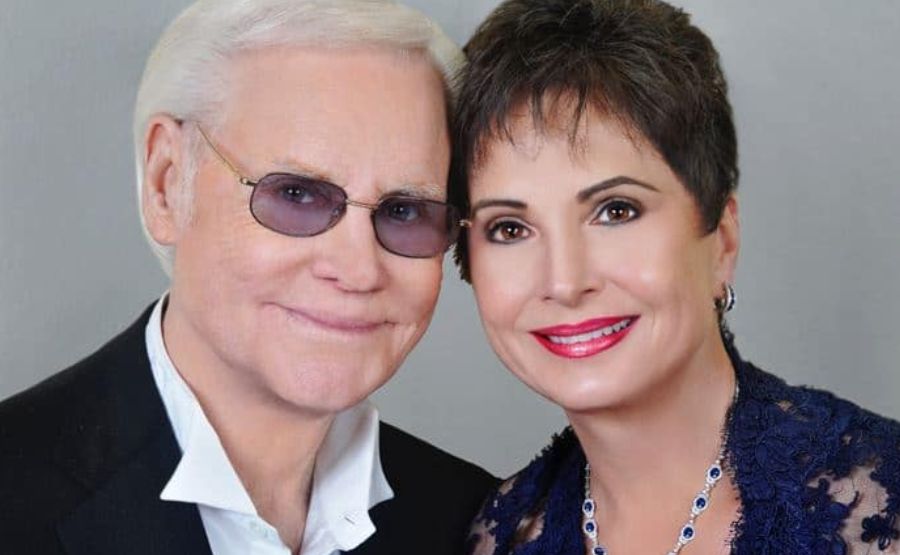
March 6, 1999: The Night That Changed Everything
The turning point arrived not through a rehabilitation program or a spiritual retreat but through violence and luck.
On the night of March 6, 1999, George Jones was driving drunk in Nashville. He was also on his phone with Nancy’s daughters, trying to play them his new song “Choices.” Something went wrong with the audio. Distracted and frustrated while fumbling with the phone, he slammed his car head-on into a concrete bridge. He was not wearing a seatbelt. His body flung forward under the steering wheel and the dashboard, and rescue crews needed the jaws of life to extract him. He died twice during the helicopter transport to Vanderbilt Hospital. Police found an open container of vodka under the front seat.
Jones survived. He had a punctured lung, blood in his chest, a ruptured liver, and badly mangled legs. The recovery was long and brutal. It was during that recovery, walking slowly on his property with Nancy, that something shifted.
Nancy has described the moment with the precision of someone who replayed it many times in her memory. She had gone to fetch the golf cart while George rested at a small bridge on their land. Walking away, she heard him praying aloud. He made a deal with God: if he survived this, he would never again drink alcohol or smoke a cigarette. He would be the husband Nancy deserved. “That moment,” she later told Americana Highways, “I knew he was telling the truth.”
“I got a perfect husband from 1999 until 2013,” she declared plainly.
The Man He Became: Sobriety and Resurrection
The fourteen years between the accident and Jones’s death on April 26, 2013, represent a sustained career and personal renaissance that would not have existed without the preceding eighteen years of Nancy’s work.
Sober, Jones became something new: consistent, warm, and almost evangelical about the possibility of change. “He became a bit of a preacher,” Nancy recalled to Fox News Digital, laughing.”He would inspire others to give up smoking and drinking by sharing how he changed his life. “If I can do it, you can too,” he would add.
Friends gave him a new nickname: Velcro. He was always stuck to Nancy’s side.
His professional reputation stabilized. He accepted invitations to the Kennedy Center, received the Grammy Lifetime Achievement Award and the National Medal of the Arts. The man once famous for not showing up became reliably present. Those closest to him understood that the transformation was not self-generated — it was the product of a long, costly partnership between his will and Nancy’s refusal to abandon him.
In his 1996 autobiography, Jones put it directly: “Friends, family, doctors, therapists, and ministers had tried to save me, but to no avail. But in the end, Nancy Jones’s love was the difference.
April 26, 2013: The Last Words
George Jones died from hypoxic respiratory failure in Nashville on April 26, 2013. He was 81 years old. Nancy was standing at the foot of his hospital bed when he opened his eyes for the last time.
She described the moment to The Tennessean in the years that followed. A doctor held her back as George opened his eyes and said, “Well, hello there. I’ve been looking for you. “My name is George Jones,” he said before closing his eyes and disappearing.
Nancy has always believed he was not talking to her. “He was talking to God,” she said. “He was speaking to God, and I know in my heart that he has gone to paradise.”
After his burial, she chose the inscription for the monument at his grave in Nashville’s Woodlawn Cemetery. It reads: He Stopped Loving Her Today — the title of the song widely considered the greatest country record ever made, and the truest summary of how their story ended.
Life After Loss: Preserving the Possum
The years following Jones’s death revealed Nancy Sepulvado as something more than a widow. She functioned as an estate executor, a cultural steward, and eventually a storyteller in her own right.
She established the George Jones Museum in Nashville, a tribute destination that opened to visitors and gave fans a physical place to engage with his legacy. The museum closed in 2021, undone by two simultaneous catastrophes: the COVID-19 pandemic and the December 2020 Christmas Day bombing in downtown Nashville, which damaged the surrounding area beyond the museum’s ability to absorb.
She established the George Jones Scholarship Fund at Middle Tennessee State University, directing resources toward the next generation of country music talent in her husband’s name. She attended the unveiling of a statue of Jones at the Ryman Auditorium. She participated in anniversary events at Woodlawn Cemetery. She took over management of his official social media accounts and has used the platform to keep his music in active circulation rather than allowing it to calcify into nostalgia.
She also pushed back, publicly, when she felt his memory was being disrespected. In 2019, she spoke out against a Nashville mural depicting Jones riding a lawnmower — a reference to a period when he was so drunk he reportedly drove a riding mower to a liquor store because his wife had taken the car keys. The mural meant it affectionately. Nancy found it reductive. “It’s plumb ugly,” she said. She did not want her husband reduced to a punchline from his worst years.
Playin’ Possum: The Book She Nearly Didn’t Write
In August 2021, Nancy Sepulvado contracted COVID-19 and nearly died. For ten to fifteen minutes, she had no pulse. Doctors urged her to go on a ventilator; her business manager helped her refuse. An infection settled into her lungs during the hospitalization and caused her to lose 70 percent of her lung capacity. Her hair fell out. She dropped to 92 pounds. She spent months in the ICU learning to walk again.
She also saw a light. She told Woman’s World, “It was the most beautiful thing I’d ever seen in my whole life.” She recovered, and the experience clarified something for her: she had not yet told the complete truth about George Jones.
The result was Playin’ Possum: My Memories of George Jones, published September 12, 2023 — deliberately released on what would have been George’s 82nd birthday — and co-authored with journalist Ken Abraham. The book is not a hagiography. It contains accounts of physical abuse. It describes the years of addiction with unflinching specificity. It also contains genuine humor and tenderness, including a story about George driving her to a restaurant half-dressed because he hadn’t noticed she wasn’t ready.
Nancy said in multiple interviews that telling the difficult parts was the hardest section to write. But she was clear about why it was necessary. She told Woman’s World, “I’m not going to say that he was an angel, but there were a lot of falsehoods.” If I would have died, who was ever going to find out the real truth about George?”
To accompany the book’s release, Nancy organized the “Still Playin’ Possum: Music and Memories of George Jones” tribute concert, filmed at the Von Braun Center in Huntsville, Alabama on April 25, 2023 — the day before the tenth anniversary of Jones’s death. Thirty-two artists performed, including Brad Paisley, Tanya Tucker, Dierks Bentley, Jelly Roll, Wynonna, Travis Tritt, Joe Nichols, and Trace Adkins. The concert was released as a Fathom Events one-night theater screening on October 17, 2023.
Legacy: More Than a Footnote
Nancy Sepulvado’s influence on country music history is structural, not decorative. Without her intervention in Jones’s finances and his personal access to substances in the early 1980s, his career trajectory almost certainly ended in ruin. Without her steady presence through eighteen years of relapse and recovery, the 1999 accident has no redemptive chapter to follow. Without her post-death stewardship, his intellectual property, public image, and scholarly recognition become contested and degraded.
The music Jones made during his sober years — the performances, the awards, the collaborations that cemented his status as, in Frank Sinatra’s reported assessment, the second-greatest singer in America — all exist in a cultural space that Nancy helped construct.
Her Playin’ Possum memoir adds a dimension that pure biography cannot provide: the interior experience of someone who chose, repeatedly and at enormous personal cost, to remain inside a difficult situation because she believed in the eventual outcome. That perspective belongs to the literature of recovery as much as it belongs to country music history.
Her daughter Adina, by some accounts, underwent serious surgery in September 2023 following a lawnmower accident that injured her heel. Nancy continues to live quietly in Woodville, Texas. She manages her late husband’s digital presence and continues advocating for the reopening or reimagining of the George Jones Museum.
Final Words
Nancy Sepulvado is not a secondary character in George Jones’s story. She is the reason the story has a final act worth telling.
Her life illustrates something that celebrity culture tends to erase: that behind enduring artistic legacies there is almost always unglamorous, ongoing human labor. Someone managing the money. Someone turned away the drug dealer. Someone sitting in the ICU beside a man who might not survive. Someone who keeps showing up when every rational calculation says to leave.
She chose a private existence, and that privacy has sometimes allowed history to undercount her. Her 2023 memoir changed that balance. Whatever people believe about the wisdom of her choices — staying through abuse, maintaining her silence for decades — the factual record of what she accomplished is clear. She restored a broken career. She helped a man find sobriety. She buried him with dignity. And she spent the decade after his death ensuring the world understood who he actually was.
George Jones called her his salvation. She called the work a divine assignment. “God put me with him to help him get the devil out of him,” she said after his death. “God put me there to do a job and I did it.”
The quiet certainty in that sentence is Nancy Sepulvado in full.
FAQs
1. Who is Nancy Sepulvado?
Nancy Sepulvado Jones is the fourth and final wife of legendary country music singer George Jones. She is known for helping Jones achieve sobriety, managing his career, and preserving his legacy after his death in 2013. In 2023, she published the memoir Playin’ Possum: My Memories of George Jones.
2. Where was Nancy Sepulvado born?
She was born in Louisiana — most sources identify Shreveport, though some cite Mansfield. Her exact birth year is disputed, with credible sources placing it in either 1953 or 1959.
3. How did Nancy Sepulvado meet George Jones?
They met in November 1981 at a concert in New York City. Nancy’s friend, who was dating Jones’s tour manager, brought her to the show. Nancy had little knowledge of Jones’s music before that night. They began dating shortly after and married on March 4, 1983.
4. Where did George Jones and Nancy Sepulvado get married?
The ceremony took place at the home of Jones’s sister, Helen Scroggins, in Woodville, Texas. It was a small, private gathering. Afterward, the couple had dinner at a Burger King.
5. Was it Nancy Sepulvado’s first marriage?
No. Nancy had been previously married and had two daughters before meeting Jones. The details of her first marriage are not publicly documented.
6. How did Nancy help George Jones get sober?
Nancy took an active, practical role from the beginning: she fired his manager and lawyers, reorganized his finances, and cut off his access to drug dealers. She supported him through multiple failed recovery attempts over eighteen years. The decisive turning point came after Jones’s near-fatal car accident on March 6, 1999, after which she overheard him pray to God and promise sobriety. He kept that promise until his death in 2013.
7. Did Nancy Sepulvado experience abuse during the marriage?
Yes. In her 2023 memoir Playin’ Possum, Nancy disclosed that George physically abused her during his addiction years. She acknowledged this openly and did not minimize it.
8. What was the 1999 car accident?
On March 6, 1999, Jones drove drunk into a concrete bridge in Nashville while distracted by a phone call. He was not wearing a seatbelt. He was extracted using the jaws of life and died twice during helicopter transport to Vanderbilt Hospital. He survived with serious injuries, including a punctured lung, a ruptured liver, blood in his chest, and badly damaged legs.
9. What were George Jones’s last words?
According to Nancy, he opened his eyes at the foot of his hospital bed and said, “Well, hello there. I’ve been looking for you. My name’s George Jones.” Nancy believes he was speaking to God. He died on April 26, 2013, from hypoxic respiratory failure at age 81.
10. What inscription did Nancy choose for George Jones’s grave?
She placed a monument at his grave in Nashville’s Woodlawn Cemetery inscribed with the title of his most celebrated song: He Stopped Loving Her Today.
11. What is the George Jones Museum?
Nancy helped establish the George Jones Museum in Nashville, Tennessee, as a tribute destination for fans. It closed in 2021 due to the combined effects of the COVID-19 pandemic and damage caused by the Christmas Day bombing in downtown Nashville in December 2020. Nancy has stated her desire to see it reopen.
12. What is the George Jones Scholarship Fund?
Nancy established the George Jones Scholarship Fund at Middle Tennessee State University (MTSU) in her late husband’s name, directing financial support toward students pursuing careers in country music and related fields.
13. What is Playin’ Possum: My Memories of George Jones?
It is Nancy’s memoir, co-authored with Ken Abraham and published September 12, 2023 — George Jones’s birthday. It covers their thirty-year marriage honestly, including accounts of his addiction and abuse, the 1999 accident, his sobriety and transformation, and his death. It also discusses Nancy’s personal COVID-19 near-death experience from 2021.
14. What happened to Nancy during COVID-19?
In August 2021, Nancy contracted COVID-19 and was hospitalized for several months. She had no pulse for ten to fifteen minutes and described seeing a brilliant light. She lost 70 percent of her lung capacity, her hair fell out, and she dropped to 92 pounds. Her recovery — and her sense that she had unfinished business in setting the historical record straight — prompted her to write Playin’ Possum.
15. Where does Nancy Sepulvado live today?
As of 2026, Nancy Sepulvado Jones lives quietly in Woodville, Texas. She manages George Jones’s official social media presence and continues working to preserve and honor his legacy. She remains alive, contrary to various false obituaries circulating online for other individuals who share her name.
Connecting curious minds with stories that educate, inspire, and inform with The Editorial Times.