
Birgit Kroencke: The Painter, the Model, and the Woman Behind One of Cinema’s Most Enduring Marriages
She outlived a legend by nine years — and in those years, as in all the decades before them, she did exactly what she always had: lived with intention, dressed with conviction, and kept her own counsel.
Quick Bio
| Detail | Information |
| Full Name | Birgit Krøncke (also spelled Kroencke / Kröncke) |
| Known As | Gitte Lee; Gitte Krøncke; Lady Birgit Lee |
| Date of Birth | April 20, 1935 |
| Place of Birth | Copenhagen, Denmark |
| Date of Death | June 20, 2024 |
| Place of Death | London, England |
| Age at Death | 89 |
| Nationality | Danish |
| Father | Richard Krøncke, Director of Tuborg Breweries, Copenhagen |
| Occupations | Model, Actress, Painter |
| Marriage | Sir Christopher Lee (March 17, 1961 – June 7, 2015, his death) |
| Duration of Marriage | 54 years |
| Children | Christina Erika Carandini Lee (born November 23, 1963, Lausanne, Switzerland) |
| Film Credits (as Gitte Krøncke) | Een blandt mange (1961); Rikki og mændene (1962); uncredited appearances in The Salamander (1981) and Safari 3000 (1982) |
| Key Fashion Work | CELINE campaign (2010); Vogue Italia (Tim Walker, 2010); Jo Malone London (2016) |
| Notable Recognition | Listed among The Guardian‘s “50 Best-Dressed Over 50s,” March 2013 |
A Copenhagen Childhood Built on Craft and Culture
Denmark in 1935 was a country still navigating the complexities of interwar Europe — a society that prized design, discretion, and Scandinavian restraint. Into this world, Birgit Krøncke arrived on April 20, 1935, in Copenhagen. The city was Denmark’s cultural capital, and her family occupied a position of quiet distinction within it.
Her father, Richard Krøncke, served as a director at the Tuborg Breweries — a major institution in Copenhagen’s commercial and social life. This was not a household of inherited aristocracy, but it was one of professional standing and cultural exposure. The Krønckes valued refinement and expected it.
The specifics of Birgit’s schooling remain unrecorded. She guarded the details of her early years throughout her entire adult life, and they remain so. What the record preserves are the products of that upbringing: a woman who moved through the world with confidence, painted with purpose, dressed with intelligence, and refused to measure herself against anyone else’s expectations.
See also “Hermine Poitou: The French Designer Who Chose the Canvas Over the Spotlight“
The Model Who Worked for Balmain, Balenciaga, and Dior
Before she became Gitte Lee — before London, before marriage, before nearly six decades alongside one of cinema’s most imposing figures — Birgit Krøncke built her own professional identity on the European fashion circuit. She modeled in the 1950s, working at a level that placed her among the most respected names in Scandinavian and European fashion.
Christopher Lee himself documented this in his 2003 memoir Lord of Misrule. When mutual friends first described Birgit to him in 1960, they listed her credentials plainly: she was a painter, a model who had worked for Balmain, Balenciaga, and Dior. Lee wrote that they showed him photographs — the red hair, the green eyes, the feline elegance — and that the images stayed with him. That is the portrait of a woman operating at the highest register of mid-century European couture.
She was not a peripheral figure in fashion. She was a professional in a field where professionals were scarce and standards were demanding. The houses she worked for — Balmain, Balenciaga, Dior — defined the aesthetic language of postwar European style. Her career there was not a stepping stone. It was a success in and of itself.
An Acting Career: Brief, Specific, and Honest
Birgit’s film work was limited in scope and entirely without pretension. She appeared in her debut Danish film Een blandt mange in 1961, credited under the name Gitte Krøncke and playing a character identified simply as Mannequinen. The following year, she took the role of Prostitueret in Rikki og mændene (1962). Both films belong to Denmark’s domestic industry of the period — unpretentious productions, not vehicles for star-making.
She also appeared in two international productions in the early 1980s: The Salamander (1981) and Safari 3000 (1982), both in uncredited cameo roles. By then she was married to Christopher Lee and appeared, in both instances, in productions that involved him. The appearances were not career moves. They were moments of proximity.
She made two television appearances as herself — a brief slot on London aktuell in 1969 and a more memorable appearance on This Is Your Life in 1974, as the wife of the show’s subject. The acting career, such as it was, tells a coherent story: Birgit tried it, did it competently, and moved on. Her real creative life was lived elsewhere — on canvas, and in the construction of her personal style.
The Meeting: Copenhagen, 1960, and a Perfectly Managed Introduction
In Lord of Misrule, Christopher Lee describes the encounter with his usual dramatic delight. He was in Copenhagen in 1960, single at a time when the married people around him apparently could not tolerate that condition. A couple — Danish friends — insisted they knew the one person in the world for him. She was twenty-five. She was known as Gitte. Her father ran the Tuborg brewery. She painted. She had modeled for the great Paris houses.
They were introduced. The courtship moved with speed unusual even by the standards of a man who had already been engaged twice before. Lee pressed her to marry him repeatedly over several days. Her father, Richard Krøncke, received him with genial indifference, reportedly offering the opinion that he had begun to wonder whether his daughter would ever marry at all.
Lee proposed with his mother’s engagement ring, which had been sitting in his cufflinks box since a previous engagement had ended. There was something characteristically theatrical about the whole sequence, and something entirely untheatrical about Gitte’s role in it: she evaluated the situation, said yes, and got on with things.
March 17, 1961: A Wedding in Chester Square
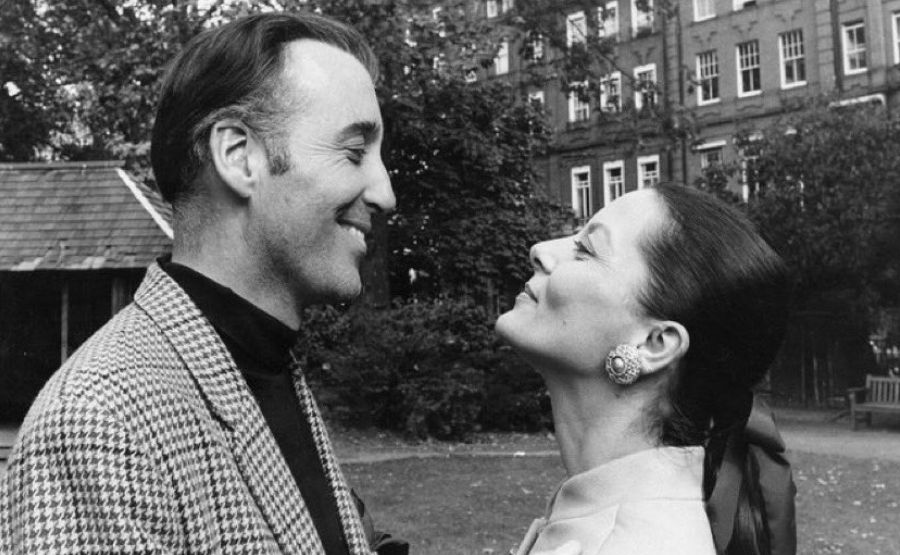
The ceremony took place at St. Michael’s Church in Chester Square, London, on March 17, 1961. It was a private occasion. Christopher Lee was 38, an actor who had spent three years establishing himself as Hammer Film Productions’ Count Dracula — a role that gave him international recognition but also threatened to confine him permanently to horror. Birgit Krøncke was 25, a Copenhagen-born model with Paris credentials and her own sense of where she wanted her life to go.
Photographs from that day show a couple leaving the church — him towering at 6 feet 5 inches, her composed and elegant beside him. They look purposeful. They do not look like people performing happiness for cameras.
In an industry that consumed marriages as casually as it consumed everything else, theirs would last 54 years — until the morning of June 7, 2015, when Christopher Lee died at Chelsea and Westminster Hospital from respiratory failure and heart failure, aged 93. Birgit did not release the news publicly for several days, notifying family and close friends first. That decision — protective, private, deliberate — was entirely in character.
Personal Life: The Architecture of a Half-Century Partnership
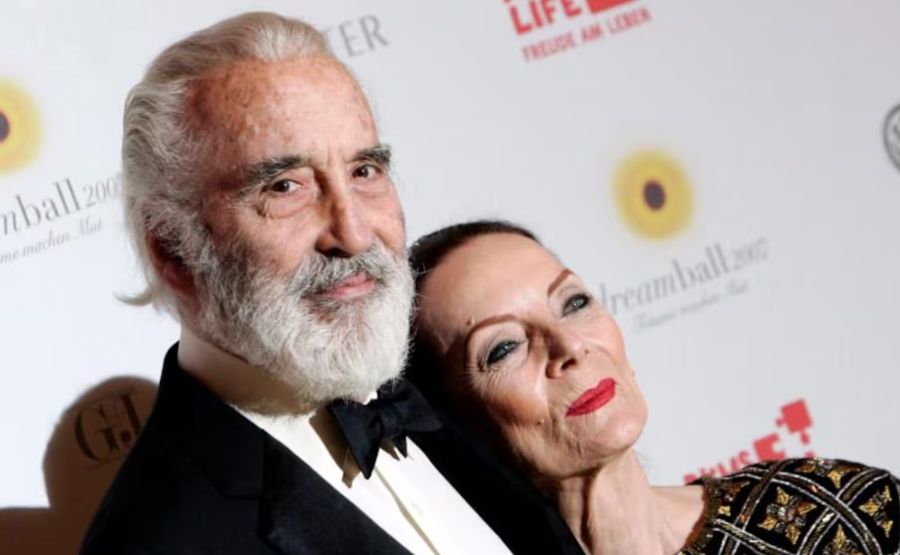
They lived for many years in Cadogan Square, Knightsbridge — one of London’s more elegant residential addresses, close enough to the city’s cultural life but removed from its noise. Christina Erika Carandini Lee, their only child, was born on November 23, 1963, in Lausanne, Switzerland, and grew up in this home. Press accounts from the period occasionally captured the three of them together at public outings — father, mother, daughter, a closed and affectionate unit.
The family also moved to Los Angeles in the 1970s when Lee, disillusioned with the roles available to him in Britain, decided to try his luck in Hollywood. That period ended, and they returned to London. Life between continents, between the demands of a husband with a global film career and the needs of a household and a child, required the kind of logistical and emotional management that rarely draws public attention.
Christina eventually married Juan Francisco Aneiros Rodriguez in July 2001. She built a life in publishing rather than entertainment, a choice that reflects the values of the home she grew up in: intellectual, private, not interested in the leverage that a famous surname might provide.
While Christopher Lee became publicly celebrated as the man who had played Dracula seven times, Saruman in Peter Jackson’s The Lord of the Rings trilogy, and Count Dooku in two Star Wars films, Birgit moved through that fame with apparent equanimity. She accompanied him to film premieres, award ceremonies, and cultural events across Europe and the United Kingdom. She was present at the University College Dublin tribute in November 2011, on the 164th anniversary of Bram Stoker’s birth, when Lee received honorary life membership of the UCD Law Society and described it as “in some ways as special as the Oscars.” She was there, beside him — noted, visible, and saying nothing to the press that would find its way into print.
Painting: The Private Language of a Private Woman
Birgit was a painter before Christopher Lee knew her name. It was one of the facts the matchmaking couple used to describe her to him, placed alongside her modeling credentials as evidence of a complete, creative person. She maintained her painting throughout her marriage, throughout the decades in London, throughout the years after Lee’s death.
The content and style of her paintings are not widely documented in any public source. She did not exhibit commercially in ways that generated reviews or catalogue essays. She did not submit to artist profiles or grant interviews about her creative process. Her painting was hers — a private language, pursued for its own value rather than for the construction of a public artistic persona.
This is, in its own way, a statement. In a culture that equates creation with exhibition, Birgit Krøncke made art for internal reasons and kept most of it there. What she communicated to the public she communicated through other means: how she dressed, how she carried herself, what she chose to appear in and what she did not
The Return: Vogue Italia, Advanced Style, and Ageless Presence
In 2010, something unexpected happened. Birgit Krøncke — then 75 years old, the wife of a famous actor, a woman who had spent decades operating at the periphery of public attention — stepped in front of Tim Walker’s camera for Vogue Italia.
Walker is not a photographer who does ordinary work. His visual style is theatrical, literary, and technically demanding. The shoot paired Birgit with the Belgian model Hannelore Knuts, and the resulting images ran in Italy’s most prestigious fashion magazine under the framing of ageless elegance. The fashion blog Advanced Style, which documented older women who had maintained distinctive personal style, featured her that year and called her “amazing.”
When Vogue Italia published a brief interview alongside the photographs, she offered a single quotable observation: “Don’t waste your time: get on with it.” She elaborated slightly — the worst aspect of aging, she said, was that you had less time remaining for all the things you had not yet done. It was the philosophy of a woman who had never confused busyness with productivity, never confused visibility with achievement, and had no patience for either complaint or delay.
The CELINE campaign of 2010 came in the same period. Jo Malone London featured her in 2016, when she was 81 years old. In March 2013, The Guardian named both Birgit and Christopher Lee among its “fifty best-dressed over 50s” — a recognition that acknowledged her as a style figure in her own right, not merely as an accessory to his celebrity.
Widowhood, Legacy, and a Final Decade of Quiet Stewardship
When Christopher Lee died on June 7, 2015, the entertainment world’s response was immediate and enormous. He had appeared in more than 250 films across seven decades. He had been knighted for services to drama and charity in 2009. He received the BAFTA Fellowship in 2011 and the BFI Fellowship in 2013. His Oscar tribute came at the 88th Academy Awards on February 28, 2016.
Birgit managed the announcement of his death with the same protective instinct she had applied to their entire marriage. She ensured that the family learned before the press did. Then she stepped back from public life almost entirely.
On September 29, 2015, she made a confirmed post-death public appearance at the American Airlines-hosted “Above / Beyond” event at One Marylebone in London. After that, the photographic and press record goes largely dark. She gave no lengthy interviews. She issued no memoir. She made no documentary. She apparently did not seek to convert grief into public narrative.
Her role as guardian of Lee’s legacy did surface in one documented instance that illustrates her character precisely. When the production team behind the 2024 animated film The Lord of the Rings: The War of the Rohirrim considered using archived recordings of Christopher Lee’s voice for the character of Saruman, screenwriter Philippa Boyens contacted Birgit directly. Boyens later described the exchange publicly: Birgit said that Christopher would have wanted this. That single observation — delivered with clarity and certainty by a woman who had lived 54 years beside the man in question — resolved the question. His voice appears in the film.
Birgit Krøncke died at her home in London on June 20, 2024. She was 89 years old.
Legacy and Lasting Influence
What Birgit Krøncke leaves behind operates across several registers, none of them loud.
As a fashion figure, she demonstrated that style is not a product of youth, budget, or editorial access. Her return to campaign work in her seventies — for CELINE, for Vogue Italia, for Jo Malone London — arrived at a cultural moment when the industry was beginning to interrogate its own obsession with youth. She did not arrive as a symbol or a statement. She arrived as herself: the same woman, the same silhouette, the same posture, decades on. The Advanced Style community recognized in her what the broader fashion world was slowly coming to acknowledge. Real style does not require renewal. It simply continues.
As a partner and collaborator, she protected and preserved one of the most significant careers in twentieth-century cinema without making that protection the defining feature of her public identity. The decision to contact the War of the Rohirrim team, to give the blessing that allowed Christopher Lee’s voice to reach a new generation of audiences, was an act of intimate knowledge — the knowledge of someone who understood not just what a person had done, but who they were.
As a mother, she brought up a daughter who eschewed the allure of a renowned father’s name in favor of publishing, married in private, and created a life on her own terms. That isn’t a temperamental coincidence.It is an inheritance of values.
And as a painter — a painter whose work remains largely unseen by the public, who kept her canvas life private for nine decades — she represents a principle worth stating plainly: creation does not require an audience to be real.
Final Words
Birgit Krøncke lived eighty-nine years across three countries, two careers, multiple identities, and one marriage that lasted longer than most professional relationships manage. She died in the city where she had spent most of her adult life, at home, in June 2024, three months after what would have been her husband’s 102nd birthday.
She is not easily categorized. She was neither a conventional celebrity wife nor a frustrated artist suppressed by her spouse’s fame. The evidence suggests she made genuine choices at every stage: to model, to stop; to act briefly, to stop; to paint privately, always; to appear in campaigns at 75 when the work interested her; to speak concisely in the interviews she gave and say nothing in the ones she declined.
The Vogue Italia interview produced one line that functions as something close to a manifesto: “Don’t waste your time: get on with it.” Whether applied to fashion, aging, grief, or creative life, it is the philosophy of a woman who had thought carefully about what she valued and had no intention of spending energy on anything else.
Her husband was one of cinema’s great presences — commanding, multifarious, physically imposing in ways that made directors reach for him whenever they needed authority on screen. Beside that, Birgit chose groundedness rather than retreat, engagement rather than subordination. The Guardian put them together on the best-dressed list in 2013 because they functioned as a unit — two people who had each, separately, decided how they wanted to move through the world and had found that their decisions were compatible.
She outlived him by nine years. She spent those years doing what she had always done: honoring the things that mattered to her, protecting the people she loved, and declining to make it anyone else’s business. That is, by any serious measure, a life well conducted.
FAQs
1. Who was Birgit Kroencke?
Birgit Krøncke (also known as Gitte Lee) was a Danish model, actress, and painter born in Copenhagen on April 20, 1935. Christina Erika Carandini Lee was born to her and her husband, Sir Christopher Lee. She died in London on June 20, 2024, aged 89.
2. Where was Birgit Kroencke born?
She was born in Copenhagen, Denmark. Her father, Richard Krøncke, was a director at the Tuborg Breweries in Copenhagen.
3. How did Birgit Kroencke meet Christopher Lee?
A Danish couple introduced them in Copenhagen in 1960 after describing each to the other at length. Christopher Lee documented the meeting in his 2003 memoir Lord of Misrule, writing that the couple showed him photographs and pressed the introduction with considerable enthusiasm. The two met soon after and became engaged quickly.
4. When and where did Birgit Kroencke marry Christopher Lee?
They married on March 17, 1961, at St. Michael’s Church in Chester Square, London.
5. How long were they married?
Fifty-four years — from March 17, 1961, until Christopher Lee’s death on June 7, 2015.
6. Did Birgit Kroencke and Christopher Lee have children?
Yes. Their only child is Christina Erika Carandini Lee, born on November 23, 1963, in Lausanne, Switzerland. Christina later married Juan Francisco Aneiros Rodriguez in July 2001 and built a career in publishing.
7. What fashion houses did Birgit Kroencke model for?
Christopher Lee’s memoir records that before they met, she had worked as a model for Balmain, Balenciaga, and Dior — three of the most prestigious houses in mid-century European couture. Later in life, she starred in the Jo Malone London ad (2016), modeled for CELINE (2010), and was photographed by Tim Walker for Vogue Italia (2010).
8. What films did Birgit Kroencke appear in?
Her credited film roles include Een blandt mange (1961) and Rikki og mændene (1962), both Danish productions, where she appeared under the name Gitte Krøncke. She had small uncredited roles in The Salamander (1981) and Safari 3000 (1982). Additionally, she made appearances as herself on This Is Your Life (1974) and London Aktuell (1969).
9. What was Birgit Kroencke’s connection to the 2024 Lord of the Rings anime?
The production team behind The Lord of the Rings: The War of the Rohirrim contacted Birgit to ask permission to use archived recordings of Christopher Lee’s voice for the character of Saruman. According to screenwriter Philippa Boyens, Birgit gave her approval, stating that Christopher would have preferred to have his voice used. The film was released in 2024, shortly after Birgit’s death.
10. Was Birgit Kroencke recognized for her style?
Yes. In March 2013, The Guardian included both Birgit and Christopher Lee in its list of “fifty best-dressed over 50s.” The Advanced Style blog featured her around 2010, following her appearance in Vogue Italia.
11. What is her most quoted statement?
In the Vogue Italia feature from October 2010, she told the interviewer: “Don’t waste your time: get on with it.” She elaborated that the worst part of aging was having less time remaining for things not yet done.
12. Where did Birgit Kroencke and Christopher Lee live?
Their long-term family home was in Cadogan Square, Knightsbridge, central London. They also lived in Los Angeles during the 1970s when Lee was pursuing roles in Hollywood, and they had connections to Switzerland, where Christina was born.
13. How did Birgit Kroencke handle Christopher Lee’s death?
She delayed releasing the news publicly, notifying family and close friends first. After that, she largely withdrew from public life, giving no extended interviews and making few public appearances in her final years.
14. What was Birgit Kroencke’s relationship to painting?
She was identified as a painter before Christopher Lee knew her — it was one of the first things his matchmaking friends told him about her. She maintained a private painting practice throughout her life, though her work was never publicly exhibited in any commercially documented way.
15. When and where did Birgit Kroencke die?
She died at her home in London on June 20, 2024, at the age of 89. Old age was identified as the cause of death.
Connecting curious minds with stories that educate, inspire, and inform with The Editorial Times.